Unless one is endowed with a toxic level of ego, we all experience times of self doubt, and that increases as one tries to accomplish things of varying scales. I'm currently going through that sort of problem.
I'm reading one of my stories on my Kindle, and all sorts of mistakes are jumping out of me that I never noticed during editing. And I just keep thinking: How did I miss this? Did I really write that? Where did I go wrong? To me the wording and sentence structure feel as smooth as sandpaper, and the minor grammar mistakes are like splinters of bamboo under my finger nails. I don't know if this is due to me holding my own stuff to higher standards due to the fact that it's mine, or if it really is as agonizing as it feels. I can only imagine what other people think. Honestly I'm horrified.
Not that these mistakes were due to laziness or lack of effort. I went over it time and again, trying to fix problems, find mistakes, and smooth things out. But that's part of the problem. When you're editing your own stuff, you inevitably miss things. At a certain point you start seeing what you expect to see, not what's actually there. It's this weird mental trick that I just can't get past. This is where a fresh set of eyes helps out tremendously.
But unfortunately I'm working almost exclusively by myself. I want beta readers. I want an editor to help catch these problems, to help channel my stuff. I don't mean to make excuses. Normally I actually accept more responsibility than is actually mine when things are at fault. But I'm now forced to acknowledge that I'm probing my limitations as a self editor. But reading all of these flaws eats away at my confidence like battery acid.
Am I actually any good at writing? I know some people say that I am. So far I haven't gotten any negative comments except from myself. But are others just being nice and not willing to point out the problems that they see? Getting better requires ruthless honesty to cull those mistakes. Am I shouldering more responsibility than I can handle? I wish I could hire an editor. That would help tremendously. But I simply don't have the funds to do so. My friends are either unqualified or are up to their eyeballs in their own problems. How can I ask them to read my stuff when they are dealing with their own intense hardships?
Nor do I wish to sell my books if they aren't up to a certain level of quality. I have a sense of honor about me. I can't in good conscience tell someone to buy something if I don't believe that it's worth their time and money. Is my stuff actually worth it? I already try to sell them cheap. But at present I feel like a fraud. At the same time I'd like to be able to earn enough money to maybe buy some things now and then. I want to work hard on this and other projects and earn enough to have a decent living. Heck, someday I'd like to have a family, and it'd be nice if I could actually support them like a man, husband and father actually should. I've got no one relying on me now, and given my dating skill that isn't likely to change, but there's always the risk.
I want to get good at this. I want to entertain people. I want to make their lives better by making them forget the crap going on in life by using words to take them to other worlds and whisk them away on grand adventures. But if this is the height of my capabilities, I'm in for trouble.
Maybe I'm being overly dramatic. Maybe this stuff just stands out to me because it's what I made, and nobody else cares about the mistakes. Maybe they aren't actually as big as I'm making them out to be. Maybe I actually am writing good stories and it's just taking time for people to get wind of them. But I just don't know.
Chances are most of you out there aren't the commenting type, but this would be a good time to get a few. I want to know the honest thoughts of you folks reading this. Don't BS me. I need harsh truth. I really need some help with this, and I'd really appreciate anything you all can give me. Sorry if this blah-fest bored you. I'll try to have something better soon.
Friday, March 9, 2018

Thursday, March 8, 2018
The Winchester 94 450 Marlin
 |
| Winchester 94, bigger and badder |
But that's not to say that they can't adapt. Winchester has shown that the vaunted 94 is capable of even more than even its greatest adherents could have suspected. For the longest time the 94 has been seen as a medium cartridge class rifle, firing thirty and sometimes thirty five caliber pills at modest but serviceable velocities. Firing the big 45 pills was the business of 86's and 95's.
But now that's changed!
The new 94 has somehow been stretched to its utmost limits and is now chambered in the potent 450 Marlin. For those unfamiliar with this cartridge, it was an attempt by Marlin to have a modern big bore cartridge capable of taking big and dangerous game at modest ranges, meant to compete with the old war horse, the 45-70. It's a full-size belted magnum, something normally seen on old African cartridges. Nothing was actually wrong with the 450. It was a solid performer and did all that was asked of it. So why is it not more popular?
Well, the 45-70, it's ancient opponent, proved to still have plenty of fight left in it. Despite its age, the 45-70 is one of the most versatile and reliable cartridges of its class. It can be loaded to very low pressures and take deer and similar sized game like a champ, but can be stoked with bigger powder charges and modern bullets to take just about anything within its shooting range. Vince Lupo famously used the 45-70 in the Marlin 1895 lever action to take Africa's Big 5. It slew hippo, lion, leopard, Cape buffalo and elephant all with authority. Despite never being envisioned to do what it's been called on to do, the old cartridge has proven to have extraordinary potential in modern frames, able to be loaded to fantastic pressures, even though the 450 Marlin is meant to do all of that from the get-go.
The 450 Marlin was the youthful upstart coming for the throne of the aging and supposedly washed up 45-70 Government. But it was trying to fill a niche that was already filled. But with this new concept of a big bore 94, the 450 was given a new chance at life. In the picture below you will notice the big fat rim on the 45-70. That seemingly insignificant bit of pudge creates a problem with feeding in some platforms. Heck, it's length and width were what made it such a devil of a cartridge to fit into leverguns in the first place! But the 450 Marlin is a bit more narrow in the hips even with the addition of the belt, and thus was selected for the new line of 94's.
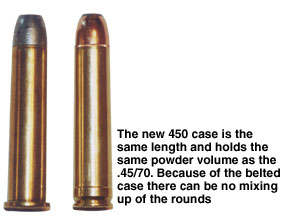 |
| 45-70 on the left, 450 Marlin on the right |
I must admit, it seems to be a good match up. Somehow what was considered a lightweight rifle, a carbine best suited for those with chronic nostalgia, has now been imbued with a wonderfully potent big bore cartridge. The 94 is one of the lightest, fastest and best handling arms out there, having fought from the snowy permafrost of Northern Canada, all throughout the dusty Old West and even into the steaming jungles of the Amazon and consistently given stellar performance. And now its paired with one of the most efficient modern big bore cartridges. This can safely tame any game you can come across in the New World, and most if not all of the Old World, if you feed it the right loads.
It's still packing six rounds in the tube magazine, with a seventh up the spout if you like being prepared for Comanche raids at any time, and all in a platform just a hair over three feet long. I'm amazed at the compact design combined with raw power.
Although it's likely to give a devil of a kick, what with having such a strong cartridge in a light six and a half pound gun, the designers had the wisdom to grant it an integral muzzle break and butt pad, so hopefully broken collar bones will be at a minimum. It's also been graced with side-ejection, allowing scope mounting, swivel studs and best of all, iron sights! I confess, I turn my nose up at most bolt actions today because they are robbed of their dandy iron sights. True, scopes allow better sighting and shooting at long ranges. But there is a sense of independence and reliability with old irons. I just can't be cured of that love.
Take a look if you can find one! This will be a contender with Marlin's impressive 1895 Guide Gun. I admit, I want one. The 94 might be old, but it's got plenty of life left in it. Take note gun makers! Some of these old pill pushers will crawl back out, no matter how much you try to bury them!
475 Linebaugh Levergun
Big Horn Armory hasn't been idle in the years since they delightedly released their Model 90 460 S&W lever action rifle. And boy have people been happy to hear about it. In the interim they've been polishing their craft, releasing ever refined improvements and have now released a levergun in yet another cartridge in their Model 90 frame. This time it's chambered in the venerable .475 Linebaugh cartridge. For those unfamiliar with the cartridge, it's a trimmed down 45-70 meant for big game hunting in revolvers, much like its cousins and is most certainly in the same league as the 454 Casull. but with a slight edge in bore diameter.
 |
| Big Horn Armory Model 90 .475 Linebaugh |
As you can see, it's still a ruggedly handsome rifle based on the staunch Winchester 1886 and 92 frames, using vertical locking bars to hold the square bolt in place. It's an efficient and durable design that has lasted for over a century. And now it's stoked with yet another potent magnum-class pistol cartridge. It can comfortably handle most if not all big game in North and South America, provided one is using the appropriate loads for the game they are hunting. Stoked with heavy duty solids this handsome gun can handle brown bear, bison and moose, although it wouldn't be my first choice.
Then again, that being said, if offered to me for such tasks I wouldn't hesitate a moment to give it a try.
I hope these boys keep up the good work. If you want to learn more of their products take a look at their site here: http://www.bighornarmory.com/
Tuesday, February 27, 2018
Political Spectrum: More Than Left and Right
All of us are aware of the general idea of the political spectrum. Generally speaking, those on the Left favor a larger government with more power and responsibility, while those on the Right put more emphasis on smaller government and more power to individual citizens. Between these two are a wide array of different people, groups and ideas. These include everything from gun rights to gay rights, immigration to traditionalism and a vast array of others that I won't list here.
While convenient for casual use, the simplicity of Left and Right is inherently limited and fails to tap into the far greater complexity represented by those within them. If you dig deeper, you will find people identifying themselves as moderates. Usually these are people with beliefs of both sides, somewhere in the middle. Yet this too fails to really take much into account. Two or three groups is a gross oversimplification for the sheer variety of individual opinions and beliefs. This also becomes troublesome when those engaging in debate use examples of extremists to paint the whole as flawed. This inevitably results in everyone within a broad belief being painted with the same brush of guilt. Those on the Left are accused of all being Communists and those on the Right of being intolerant religious bigots.
Yet despite sharing similar beliefs, these people may in fact disagree heartily with the extreme elements.
It is for this reason that I hope to delve deeper into these intricacies and shed light on a new perspective that might help in the current political environment. I will start simple, but slowly show more complex examples.
First, imagine a square. Now imagine a line drawn down the middle from top to bottom. You then of course have the Left and the Right. For simplicity's sake, let us say there is no Moderate. Now, on both sides you have good and bad people. Some are tolerant of those who disagree with them, others react with open hostility. But how to tell one from the other? Negativity grabs attention far more than positivity. If one does something wrong, it is seemingly shared collectively across the board. They are on the same side, and thus tar the whole with their bad deeds, whether it is an action, statement or belief.
But now imagine another line, one drawn from the sides horizontally. Now instead of two rectangles, the Left and Right, you now have four squares, Up and Down. Imagine now that the Down is for those who represent hostility, violence, intolerance and in general behavior considered uncivilized or dangerous. Up represents those who are tolerant, kind, helpful, and even extend generosity to those on the opposite side of the square.
This introduces a very different dynamic. Left Down can be considered extremists you see on TV who blacklist their opponents or call for the silencing or deaths of others. But Left Up consists of those who disagree with those on the Right, but hold no ill will towards them and respect their beliefs and standings. The same with the Right. There is the Right Down which includes those who wish to harm Leftists, both Up and Down, who take extreme positions and are openly hostile to those who disagree. But there is also the Right Up. Like the Left Up, they are tolerant, enjoy political debate, and don't shy from interacting with those different from them.
Now suddenly we can view things with greater precision. Instead of now identifying Leftists or Rightists as inherently bad based on the actions of a minority from their half of the square, now we can divide them based not just on beliefs, but on behaviors and most importantly, actions. This also allows us to fight against disagreeable elements that are technically on the sides we are on. For the Left, this could be classical liberals debating with hard core communists or fascist socialists. For the Right it could be classic conservatives arguing against extreme anarchists or fanatical Trump supporters. Despite technically sharing the same inherent base beliefs, the degree to which they hold to them and how they treat others as a result shows a great deal of difference.
Often in this heated political climate we are somehow forced to defend those who are deplorable by the simple virtue that they technically are on our side. I find this unacceptable.
Political beliefs come in degrees, not in absolutes.
Continuing with the example of the squares within squares, let us get much more complex. What many don't seem to be willing to acknowledge is that there are those considered to be on one political side that share some beliefs of the other. There are Leftists who support gun ownership rights, capitalism and religious freedom. There are Rightists who support gay rights, immigration and some level of government assistance.
Let us take the view of government assistance with personal lives as an example. Let us start with the with the middle and go Right. The middle would be some level of government assistance in the lives of citizens. Social Security cards, the DMV, various licensing, stuff that you most likely see as reasonable for everyday use. There are taxes and fees for small processes undergone. We nudge to the Right and see the desire for less government involvement in say, welfare. At first it's just a gradual reduction. Perhaps those on welfare have a slightly reduced volume of benefits. A little less in the welfare checks, a little less Medicare, etc, in the hopes of saving tax money from those who aren't on welfare and prompt those who are into improving their situation. Nothing drastic.
Take a step further. Some programs will be greatly reduced. Those who milk the system will be up in arms, but there are even some on the Left who can acknowledge that some such steps are necessary. After all, if someone has the physical means to work and simply chooses not to, should he or she really receive benefits? This falls within the Moderate Right. But then let us get more extreme. You find those who not only want to reduce programs, but get rid of many altogether. Eliminate Affirmative Action, Medicare, Medicade, and a host of other programs. This is opposed vehemently by many on the Left, but most on the Right support.
Take it to the hard core extreme, and introduce the idea of no government assistance whatsoever for anyone. This will make even most Rightists pause. After all, some will argue, correctly, that there are some who do need help. What if someone is crippled in an accident and unable to care for themselves, but are not affiliated with any church to help them or have no family. What then? Obviously, such a person needs help. What about the man trying to support his family, but has been laid off through no fault of his own? Times can be bad, and purely through circumstance be in a very bad spot. But this man seeks only to have enough help to get him through this bad patch until he can get back on his feet. A temporary boost. This is something that we can all clearly sympathize with and acknowledge as a case where some help is necessary. After all, if a mother is widowed and she has children who need to be fed, but she can't find a job because she must watch them, what else is to be done? Suddenly most Rightists sound like Leftists! In such an event many Rightists would acknowledge that there need to be cuts, certainly, but would equally acknowledge the need to help those who are simply beyond normal help. They first advocate receiving help from friends, family and church, with government help as a last resort. But it is still a resort that may be reached, and thus there must be some level of government assistance for those who truly need it. To forego any and all help entirely, to the point that it is more akin to anarchy where everyone must fend for themselves, would be more than most could stand.
The lines blur, don't they? Now lets go to the Left and see the layers there.
On the Moderate Left you have those who believe many are in very difficult circumstances that need help from the government first and foremost. After all, not everyone has reliable friends, family or other organizations to help them where they live. These people are to receive help in the form of food stamps, government housing and medical help. Those on the Moderate Right can see this point of view and sympathize with it, but disagree on terms of how much of these things are received.
Go further Left. We see those who believe that government should not only supply the basics of life, but provide help with continued schooling and college. After all, college is a very important means of acquiring knowledge and securing a firm career with high pay to support ones self and family. Most of the Left agree with this. It requires raised taxes, but they see that as a duty and a privilege for the community as a whole.
Further still and we find the advocacy for government not only having a hand in many facets of life, but controlling them. They see the mistakes widely made by citizens and believe that control should be transferred to those in government and have a much larger hand in how people conduct their lives. Here we come to socialism. But you will find some Leftists a little worried when they learn that they will be taxed much more heavily for programs that do what they can do by themselves. After all, they are happy to help others by paying taxes, but not at the cost of being plunged into poverty themselves through taxes too heavy to be sustained.
Jump to the extreme of the Left and you find people advocating the confiscation of not just money through taxes, but personal property, cars and even homes! Here many Leftists will openly oppose such measures. It's one thing to help someone find a home, but to provide it by robbing others and throwing them on the street is another matter altogether. They find their pockets emptied through taxes, their purchases confiscated as being a waste of money and turned over to others, and most facets of their lives intruded upon. In fact some Leftists might eagerly assist this process through vandalizing and robbery. Other Leftists would be horrified as they see citizens and businesses pillaged and openly condemn such behavior. Others on their same side will suggest that those being robbed deserve it. It would be contested that yes, there are perhaps those who must give up some of what they own to help others, but to carry out such action through violence and destruction is unacceptable. Here it will be widely acknowledged that this is too far, and we see the elements of the same side divided amongst themselves.
See how the pendulum can swing so far from one side to the other, yet be pulled back by the side it is swinging towards? The extreme sides of both exist and must be reined in. Nor is this behavior limited only to government assistance. It applies to each and every issue we discuss politically.
In fact, far from being simple Left or Right, there is a field of overlap and varying degrees of political belief. It comes in degrees, not absolutes. To visualize this concept, now look at what we have.
Here we have a vast and wide color gradient. Now imagine that this represents all political leanings of different degrees from Left to Right, Up and Down, and you have a very real idea of what actual political leanings are like for individuals, not just groups. It is a vast spectrum. The further to the sides you get, the more extreme the belief. The closer to the middle, the more moderate. Now when you hear that someone considers themselves a Leftist, ask yourself, what kind of Leftist? How extreme or moderate are their beliefs? Same for the Rightists.
People are infinitely more complex than one simple word. In fact, even in the examples I've given of ever growing complexity, it's possible that it might become more complex still. This I can't illustrate. Perhaps I haven't even thought of it yet. These show only political leanings. But there is so much more outside of those. What is the mentality of the individual? Their upbringing? Their family? Friends? What are they afraid of? What do they like? What do they hate? Such things are all pieces of what makes up an individual person and can't be captured in any sort of graph or model.
Often in the brutal political climate today we divide ourselves on very simplistic and limiting criteria. We grow more and more aggressive towards those we perceive to be our enemies from the simple virtue of the fact that they are on a different side. It is a very dangerous thing to stray towards any extreme. Not only does it dehumanize others, but it will force your opponents to take equally extreme positions. A universal law of physics is that for every action there is an equal and opposite reaction. Politics is no exception.
I noticed this especially in the last election. I'd always considered myself very far on the Right. But then suddenly strange extremists came about and I found myself identifying as a moderate. Likewise there were many on the Left who found the continuing extremes of their side becoming distasteful and frightening. In fact, the majority of the country didn't vote for either candidate.
Through this article I hope to emphasize the humanity of all sides. Don't look at others as less than human because they believe differently from you. Don't brand all with the stamp of one side or the other. They may in fact have much more in common with you than you realize.
While convenient for casual use, the simplicity of Left and Right is inherently limited and fails to tap into the far greater complexity represented by those within them. If you dig deeper, you will find people identifying themselves as moderates. Usually these are people with beliefs of both sides, somewhere in the middle. Yet this too fails to really take much into account. Two or three groups is a gross oversimplification for the sheer variety of individual opinions and beliefs. This also becomes troublesome when those engaging in debate use examples of extremists to paint the whole as flawed. This inevitably results in everyone within a broad belief being painted with the same brush of guilt. Those on the Left are accused of all being Communists and those on the Right of being intolerant religious bigots.
Yet despite sharing similar beliefs, these people may in fact disagree heartily with the extreme elements.
It is for this reason that I hope to delve deeper into these intricacies and shed light on a new perspective that might help in the current political environment. I will start simple, but slowly show more complex examples.
First, imagine a square. Now imagine a line drawn down the middle from top to bottom. You then of course have the Left and the Right. For simplicity's sake, let us say there is no Moderate. Now, on both sides you have good and bad people. Some are tolerant of those who disagree with them, others react with open hostility. But how to tell one from the other? Negativity grabs attention far more than positivity. If one does something wrong, it is seemingly shared collectively across the board. They are on the same side, and thus tar the whole with their bad deeds, whether it is an action, statement or belief.
But now imagine another line, one drawn from the sides horizontally. Now instead of two rectangles, the Left and Right, you now have four squares, Up and Down. Imagine now that the Down is for those who represent hostility, violence, intolerance and in general behavior considered uncivilized or dangerous. Up represents those who are tolerant, kind, helpful, and even extend generosity to those on the opposite side of the square.
This introduces a very different dynamic. Left Down can be considered extremists you see on TV who blacklist their opponents or call for the silencing or deaths of others. But Left Up consists of those who disagree with those on the Right, but hold no ill will towards them and respect their beliefs and standings. The same with the Right. There is the Right Down which includes those who wish to harm Leftists, both Up and Down, who take extreme positions and are openly hostile to those who disagree. But there is also the Right Up. Like the Left Up, they are tolerant, enjoy political debate, and don't shy from interacting with those different from them.
Now suddenly we can view things with greater precision. Instead of now identifying Leftists or Rightists as inherently bad based on the actions of a minority from their half of the square, now we can divide them based not just on beliefs, but on behaviors and most importantly, actions. This also allows us to fight against disagreeable elements that are technically on the sides we are on. For the Left, this could be classical liberals debating with hard core communists or fascist socialists. For the Right it could be classic conservatives arguing against extreme anarchists or fanatical Trump supporters. Despite technically sharing the same inherent base beliefs, the degree to which they hold to them and how they treat others as a result shows a great deal of difference.
Often in this heated political climate we are somehow forced to defend those who are deplorable by the simple virtue that they technically are on our side. I find this unacceptable.
Political beliefs come in degrees, not in absolutes.
Continuing with the example of the squares within squares, let us get much more complex. What many don't seem to be willing to acknowledge is that there are those considered to be on one political side that share some beliefs of the other. There are Leftists who support gun ownership rights, capitalism and religious freedom. There are Rightists who support gay rights, immigration and some level of government assistance.
Let us take the view of government assistance with personal lives as an example. Let us start with the with the middle and go Right. The middle would be some level of government assistance in the lives of citizens. Social Security cards, the DMV, various licensing, stuff that you most likely see as reasonable for everyday use. There are taxes and fees for small processes undergone. We nudge to the Right and see the desire for less government involvement in say, welfare. At first it's just a gradual reduction. Perhaps those on welfare have a slightly reduced volume of benefits. A little less in the welfare checks, a little less Medicare, etc, in the hopes of saving tax money from those who aren't on welfare and prompt those who are into improving their situation. Nothing drastic.
Take a step further. Some programs will be greatly reduced. Those who milk the system will be up in arms, but there are even some on the Left who can acknowledge that some such steps are necessary. After all, if someone has the physical means to work and simply chooses not to, should he or she really receive benefits? This falls within the Moderate Right. But then let us get more extreme. You find those who not only want to reduce programs, but get rid of many altogether. Eliminate Affirmative Action, Medicare, Medicade, and a host of other programs. This is opposed vehemently by many on the Left, but most on the Right support.
Take it to the hard core extreme, and introduce the idea of no government assistance whatsoever for anyone. This will make even most Rightists pause. After all, some will argue, correctly, that there are some who do need help. What if someone is crippled in an accident and unable to care for themselves, but are not affiliated with any church to help them or have no family. What then? Obviously, such a person needs help. What about the man trying to support his family, but has been laid off through no fault of his own? Times can be bad, and purely through circumstance be in a very bad spot. But this man seeks only to have enough help to get him through this bad patch until he can get back on his feet. A temporary boost. This is something that we can all clearly sympathize with and acknowledge as a case where some help is necessary. After all, if a mother is widowed and she has children who need to be fed, but she can't find a job because she must watch them, what else is to be done? Suddenly most Rightists sound like Leftists! In such an event many Rightists would acknowledge that there need to be cuts, certainly, but would equally acknowledge the need to help those who are simply beyond normal help. They first advocate receiving help from friends, family and church, with government help as a last resort. But it is still a resort that may be reached, and thus there must be some level of government assistance for those who truly need it. To forego any and all help entirely, to the point that it is more akin to anarchy where everyone must fend for themselves, would be more than most could stand.
The lines blur, don't they? Now lets go to the Left and see the layers there.
On the Moderate Left you have those who believe many are in very difficult circumstances that need help from the government first and foremost. After all, not everyone has reliable friends, family or other organizations to help them where they live. These people are to receive help in the form of food stamps, government housing and medical help. Those on the Moderate Right can see this point of view and sympathize with it, but disagree on terms of how much of these things are received.
Go further Left. We see those who believe that government should not only supply the basics of life, but provide help with continued schooling and college. After all, college is a very important means of acquiring knowledge and securing a firm career with high pay to support ones self and family. Most of the Left agree with this. It requires raised taxes, but they see that as a duty and a privilege for the community as a whole.
Further still and we find the advocacy for government not only having a hand in many facets of life, but controlling them. They see the mistakes widely made by citizens and believe that control should be transferred to those in government and have a much larger hand in how people conduct their lives. Here we come to socialism. But you will find some Leftists a little worried when they learn that they will be taxed much more heavily for programs that do what they can do by themselves. After all, they are happy to help others by paying taxes, but not at the cost of being plunged into poverty themselves through taxes too heavy to be sustained.
Jump to the extreme of the Left and you find people advocating the confiscation of not just money through taxes, but personal property, cars and even homes! Here many Leftists will openly oppose such measures. It's one thing to help someone find a home, but to provide it by robbing others and throwing them on the street is another matter altogether. They find their pockets emptied through taxes, their purchases confiscated as being a waste of money and turned over to others, and most facets of their lives intruded upon. In fact some Leftists might eagerly assist this process through vandalizing and robbery. Other Leftists would be horrified as they see citizens and businesses pillaged and openly condemn such behavior. Others on their same side will suggest that those being robbed deserve it. It would be contested that yes, there are perhaps those who must give up some of what they own to help others, but to carry out such action through violence and destruction is unacceptable. Here it will be widely acknowledged that this is too far, and we see the elements of the same side divided amongst themselves.
See how the pendulum can swing so far from one side to the other, yet be pulled back by the side it is swinging towards? The extreme sides of both exist and must be reined in. Nor is this behavior limited only to government assistance. It applies to each and every issue we discuss politically.
In fact, far from being simple Left or Right, there is a field of overlap and varying degrees of political belief. It comes in degrees, not absolutes. To visualize this concept, now look at what we have.
 |
Here we have a vast and wide color gradient. Now imagine that this represents all political leanings of different degrees from Left to Right, Up and Down, and you have a very real idea of what actual political leanings are like for individuals, not just groups. It is a vast spectrum. The further to the sides you get, the more extreme the belief. The closer to the middle, the more moderate. Now when you hear that someone considers themselves a Leftist, ask yourself, what kind of Leftist? How extreme or moderate are their beliefs? Same for the Rightists.
People are infinitely more complex than one simple word. In fact, even in the examples I've given of ever growing complexity, it's possible that it might become more complex still. This I can't illustrate. Perhaps I haven't even thought of it yet. These show only political leanings. But there is so much more outside of those. What is the mentality of the individual? Their upbringing? Their family? Friends? What are they afraid of? What do they like? What do they hate? Such things are all pieces of what makes up an individual person and can't be captured in any sort of graph or model.
Often in the brutal political climate today we divide ourselves on very simplistic and limiting criteria. We grow more and more aggressive towards those we perceive to be our enemies from the simple virtue of the fact that they are on a different side. It is a very dangerous thing to stray towards any extreme. Not only does it dehumanize others, but it will force your opponents to take equally extreme positions. A universal law of physics is that for every action there is an equal and opposite reaction. Politics is no exception.
I noticed this especially in the last election. I'd always considered myself very far on the Right. But then suddenly strange extremists came about and I found myself identifying as a moderate. Likewise there were many on the Left who found the continuing extremes of their side becoming distasteful and frightening. In fact, the majority of the country didn't vote for either candidate.
Through this article I hope to emphasize the humanity of all sides. Don't look at others as less than human because they believe differently from you. Don't brand all with the stamp of one side or the other. They may in fact have much more in common with you than you realize.
Monday, February 26, 2018
Sure-Fire Solution to Stop School Shootings
Folks, I have the one and only true way to not only keep school shootings from happening ever again, but also eliminate school bullying and child-molesting teachers without spending a single cent!
How you ask? Quite simple! I'm actually surprised nobody else has suggested it. Get rid of schools!
It's just as reasonable as all the policies I've heard from other people. Bad things happen a few times with something, get rid of it altogether. That's the reasonable thing, right? Plus this way we save billions of dollars annually on taxes, teachers unions, lots of time on driving kids to and from school, no more stupid fund raisers or band. Best of all, no homework! We can all fall-back on homeschooling with online tests. The benefits are limitless!
Come on everyone! Let's work to ban schools with their intelligence shaming, sex shaming, teen shaming, shame shaming, the whole kit and caboodle. After all, it is for the children!
How you ask? Quite simple! I'm actually surprised nobody else has suggested it. Get rid of schools!
It's just as reasonable as all the policies I've heard from other people. Bad things happen a few times with something, get rid of it altogether. That's the reasonable thing, right? Plus this way we save billions of dollars annually on taxes, teachers unions, lots of time on driving kids to and from school, no more stupid fund raisers or band. Best of all, no homework! We can all fall-back on homeschooling with online tests. The benefits are limitless!
Come on everyone! Let's work to ban schools with their intelligence shaming, sex shaming, teen shaming, shame shaming, the whole kit and caboodle. After all, it is for the children!
Monday, February 19, 2018
War Of The Worlds: Goliath
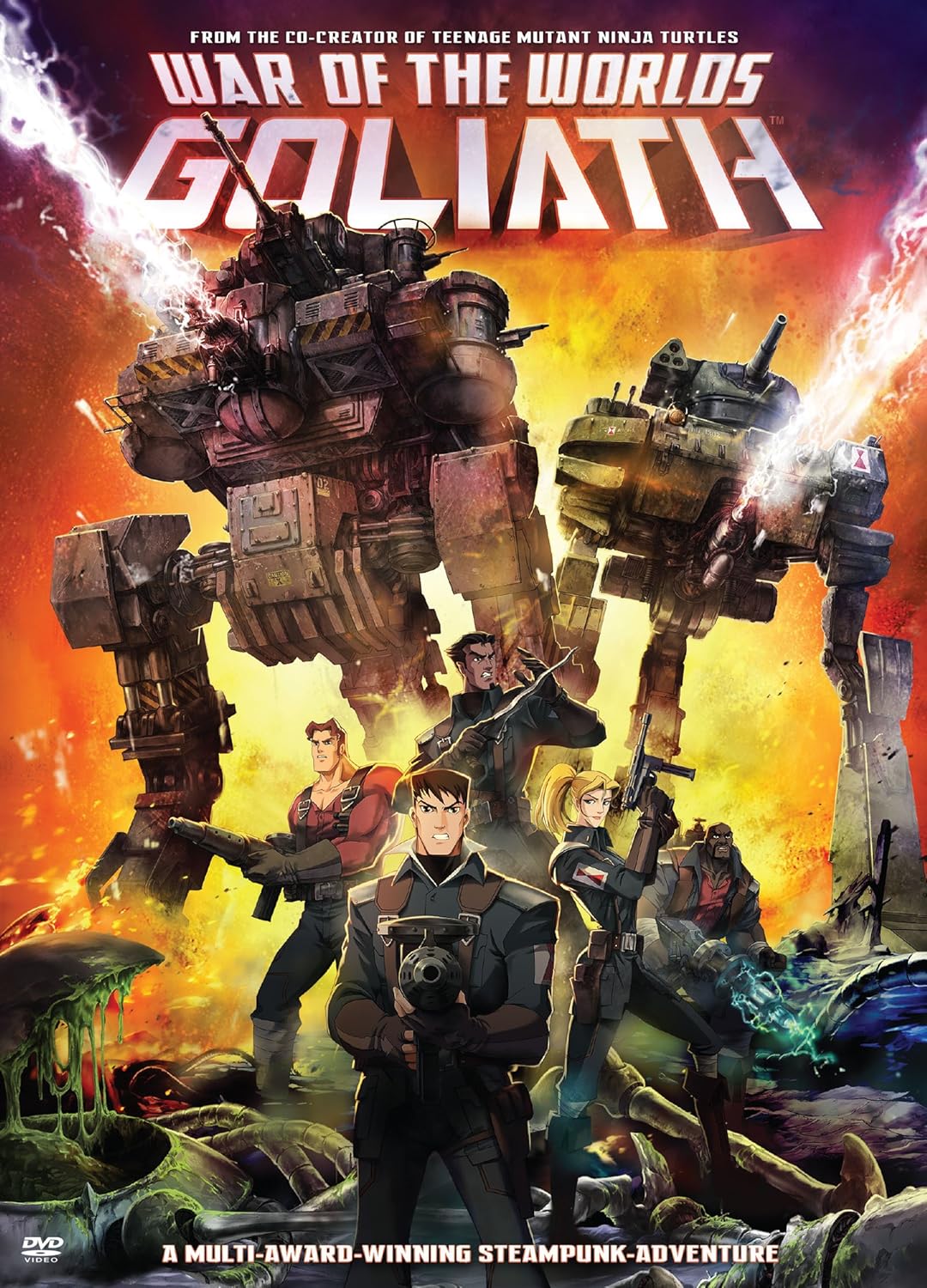 |
| War of the Worlds: Goliath |
War of the Worlds: Goliath is an awesome action adventure movie where after humanity got rocked by the first Martian invasion, they got their act together and are now ready for round two.
Plot is pretty straight forward. The best soldiers of all nations have been pulled into an anti-Martian military group called A.R.E.S, given the biggest and baddest weapons humanity has to offer including a bunch of reverse-engineered Martian weapons with the help of Nikola Tesla, who is required to be involved in all steampunk settings as required by law. Actually, the human tripods are extremely cool. Very different in design from the fluid and curvy Martian tripods, the three classes of human models are all human in design and look remarkably real.
 |
| Fantastic airship |
 |
| Body of the Achilles-Class human Tripod |
In truth, the amount of effort put into the designs and world building of this movie is phenomenal. The weapons, vehicles, equipment, absolutely everything is well done. I love looking at the concept art and schematics for everything. This is on par with the amount of thought put into Disney's Atlantis: The Lost Empire. Except this has less princesses and more death.
The year is 1914 and governments around the world are preparing for the first World War, while A.R.E.S. soldiers and their leader, good ol' Teddy Roosevelt ignore the politics and prepare for a second Martian invasion which seems imminent.
The characters are mostly archetypes. They aren't completely throwaway, but not terribly compelling either. But each of the main characters are given their moments to shine, so there is indeed some sense of anxiety when they are in danger, which is quite often.
During the first major training exercise with their new tripods our heroes come face to face with the first probing force of the second Martian invasion, and it's here that we find out that despite the animation style, this isn't a cheesy Saturday morning cartoon. In fact, one of the best things I can say about this movie is that it feels like real war. People die left and right, but it's not because of them being stupid. The Martians are a genuine threat. Their tripods are bigger, better armored and have vastly greater offensive power than anything humanity has. They shrug off machine gun and rifle fire, and require repeated hits from even heavy cannons and missiles to go down.
 |
| Martian Tripods |
Often our heroes survive simply because the Martians didn't target them. At any moment their heat rays might turn toward them, and from there it's just one sickly green ray of dazzling energy to send them into oblivion. This is actually probably the most violent animated movie I've seen since Turok: Son of Stone. You don't just see humans vanish in a puff of smoke when hit with a heat ray. You see them vaporized layer by layer. First the clothing and skin goes, then the muscle, and lastly the skeleton, all reduced to ash in a matter of seconds as they howl in agony. Its sodding violent. This is NOT a kids movie.
The combat isn't highly choreographed or graceful. It feels like real combat, chaotic and confused. Things blowing up all around you, people screaming in pain, but you just keep firing at the enemy and hope that you can kill them before they turn their weapons on you. It really feels like just a roll of the dice if someone lives or dies, even if they are really skilled or in good positions.
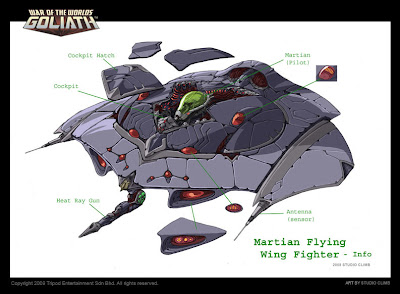 |
| Martian Fighter |
Most of the movie is action, with pauses to let us take a breath now and then. Decent pacing and great visuals make it an awesome popcorn movie. But if you want deep intellectual stimulation you'd best look elsewhere. However this movie nails what it wants to do almost perfectly.
It would be a crime not to talk about the animation. It looks like a blend of anime and Saturday morning cartoon styles. The character designs display this best. The faces and especially the eyes are angular and exaggerated. The bodies on the other hand are swollen with muscle and the clothing vacuum sealed around them so that you see every single inch of their physique. This results in an interesting melding of 80's style GI Joe and more streamlined but exaggerated anime, although it definitely leans more towards the former. I find the style overall very interesting, partly because this was actually a Malaysian production. Huh.
Regardless if you're a fan of animation or not, there is no doubt that this animation is top notch. It's magnificently smooth and fluid, and overall matches the setting and tone perfectly. Even if you aren't interested in War of the Worlds, this movie is a visual buffet. Not a cent was wasted in making this look as good as possible. Others more knowledgeable in animation than myself might very well wish to take a look at this if only to analyze it.
It's also fair to mention that although it is very action schlock, there is a definite feeling that it respects the original source material written by HG Wells. The main character is British, and if you've read the book you will notice all sorts of details that are kept in this movie. The look of the aliens is spot on. Their tripods really feel like they are alive like in the book, moving fluidly with tendrils waving about unceasingly like an organism that is rather unsettling.
It is fair to mention that although we never hear the Martians speak or anything like that, I do feel like some of them have a bit of personality and sadism just displayed through their actions. One tripod lets a lone human shoot at it, letting the bullets bounce off harmlessly, just waiting for him to run out of ammunition as if its amused with the futile attempt of doing it harm. It patiently waits for him to run dry and then methodically vaporizes him. You can almost see the Martian inside gloating with this smug sense of superiority.
In the end fight another Tripod kills a soldier as painfully as it can, wrapping the tendrils around his midsection and collapsing his ribcage. It could have simply vaporized him or snapped his neck, but instead took the time to inflict as much pain as it could. To me this really says that the Martians enjoy inflicting pain and see humanity as being far beneath them. This could very well simply be me seeing something that isn't there, but it made me enjoy the flick that much more.
I really do recommend purchasing this. Even if the movie is lukewarm for some of you, the disc set comes with all sorts of bonus material that I was only too happy to look at. Schematics for human and Martian technology, concept art, and even other stories told comic book style that really had some emotional bite to them.
It's well worth a look. You can purchase it here: http://amzn.to/2FgwQak
If you're wondering, I'm not getting paid to pimp this out. I simply believe it's a movie worthy of attention. This never got a theatrical release and is more of an underground movie. It made less than one hundred thousand dollars according to the box office reports, which is a horrible shame for something like this. They put a gigantic amount of effort into this production. I can tell the makers really cared and I want their effort to pay off.
Friday, February 16, 2018
Son of Kong
 |
| Son of Kong! |
I'm a shameless Kong fan. I watched the almighty crap out of the original as a kid. It kindled my love for black and white movies and stop motion, just as it did for countless viewers when it first came out in 1933. I thought I was one of the more informed fans. But as it turns out, a sequel exists called Son of Kong, released the same year!
After doing a bit of research I found that it is a very poorly received movie. But having just watched it, I can't say that it's a bad movie honestly. I think much of the backlash comes from the simple fact that it's a sequel to King Kong, one of the most epic movies ever made. That's a very high bar to meet. So by comparison even a half-decent movie will feel poor when put side by side with King Kong.
So what is Son of Kong about? Well, it's a direct sequel, almost months after the events of the first movie. Ann Darrow and Jack Driscoll got their happily ever after, but not Carl Denham, the movie maker who led the ship to Skull Island in the first place and brought Kong to New York. He is being sued by everyone in New York and their dog for damages. He is harassed day and night by reporters, complainers and summons to court. But Captain Engelhorn, who is in the same boat as Carl, invites him to elope with a skeleton crew and do business in the Pacific Ocean, and hopefully evade prison.
To skip ahead a bit, they end up on an island with the man who first gave Carl the map to Skull Island, Captain Helstrom, who we immediately recognize as a scoundrel, and a young lady, Hilda. Both have fallen on hard times and join aboard the ship. Helstrom, who has nothing to his name and desperate to evade authorities after accidentally murdering Hilda's dad, tells Carl that there is treasure on Skull Island and attempts to usurp the crew and ship for himself.
Now, a word is in store for the love interest, Hilda. She's not Ann Darrow. Somehow she has a lot more daring and strength to her. I really like her. In fact when we first see her, she is performing for a tiny audience and is a poor singer. But Carl doesn't care. He puts it best when she shows up. "Who cares? She's got personality!" And she does. As much as I love the original King Kong, Ann Darrow never felt that good to me. This gal is fun. She knows Helstrom conked out her dad, but she doesn't bat an eye when he threatens her. She doesn't cowtow to anyone, yet isn't annoying in her headstrong behavior.
She and Carl actually get along quite naturally. Carl is given a lot more depth in this movie. Aside from feeling bad about being in crippling debt, he genuinely feels bad for what happened to Kong. He knows he screwed up, got people hurt, and got one of the most amazing creatures in the world killed. But he's trying to do better. He sees potential in Hilda and tries to give her inspiration to keep going even when things are bad. It's not even that he's in love with her at first. He genuinely respects her as a person with potential to do better things, and even when she stows away on the ship he can't help but admire her guts.
The ship heads back to Skull Island in the hopes of finding the treasure and making a profit. But it's all a ploy by Helstrom, who gets the crew to turn against Engelhorn and Denham. Once they arrive at the island the crew forces them along with Hilda and Charlie, the Chinese cook from the original, off into a life boat to fend for themselves on the island. I think even Charlie is given a bit of a spotlight in this one, and I like it. He actually chooses to join the others on the island rather than join the scoundrels in mutiny, and even had the foresight to stow some guns and ammunition aboard. And thank heavens, he doesn't die.
But when Helstrom tries putting himself in charge, the new communist crew isn't having any of it and throw him off, and now has to put in with those who he first betrayed. Worse yet, when they first land the chief and villagers from the original, and they aren't the least bit happy to see these familiar faces, and make absolutely no bones about how displeased they are. They have no choice but to land beyond the wall near Skull Mountain where only one area is available to actually tie off. And here's the second reason I think this movie was so poorly received, even now. The movie is ninety minutes, and it's only here at the forty minute mark that we are at the island and see Son of Kong. And his son is NOT a gorilla tyrant.
First time we see him, he's tiny by comparison and stuck in quicksand.
 |
| The Terror of Skull Island stuck in quicksand |
There is a moment that is genuinely heartfelt however. After a big fight Little Kong has a big gash on his middle finger. Hilda wants to thank him for saving them and provides part of her dress as a bandage, and Carl, genuinely regretting getting King Kong killed, talks to the ape and bandages his finger. The finger that is injured however is unintentionally hilarious. Even so it illustrates how Carl has changed and is actually pretty nice.
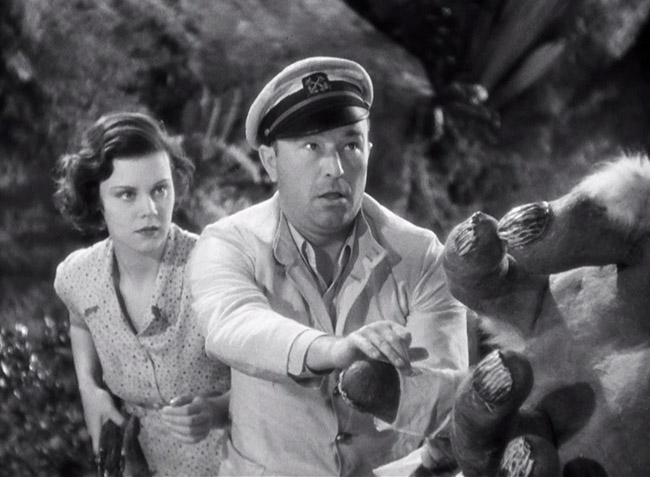 |
| Little Kong uses sign language |
But I did notice a distinct drop in stop motion quality. A few times the movement is way to fast and choppy, but it's not bad either. I will commend the use of new critters though, such as a giant cave bear, styracosaurus and others.
Carl and Hilda find young Kong trapped, and feeling the need to make up for what he did to King Kong, Carl pushes a tree over to help him escape, which works. Little Kong becomes greatly attached to the little group from this point on, helping them fight beasts that menace them or find food. It really is quite endearing. But his attempts at trying to communicate is rather awkward, and something about his head is a little off. It's difficult to explain unless you see it.
Something I really like is that they set up camp by some ruins, and Carl is ecstatic at the idea that this is where the treasure is. Lo and behold, there is treasure there! The look of the temple is actually very neat and gives us some hope that Carl and company can come out okay after this adventure.
Although I can't help but mention a point where Little Kong grabs Carl's shotgun and plays with it. He looks down the barrels, sticks it in his mouth, and does everything possible to make me, someone paranoid about gun safety, and I genuinely cried out. Oi.
Then it gets weird. Helstrom decides to rush to the boat to escape to nowhere, and suddenly out of nowhere an earthquake strikes. But evidently this is the most epic tectonic activity since Pangea split up because this event is the apocalypse for Skull Island, which not only shakes apart but falls under the ocean. As far as we know, all of the animals and natives drown horribly, including Little Kong, who heroically holds Carl above the water long enough for his friends to row over and rescue him. This is the one part that I really didn't like. It comes out of nowhere, Little Kong is dead, and the entire population of the island is exterminated. It left me feeling sad.
But it ends on a positive note. Helstrom is fittingly dead, and Carl rescued a handful of gold and diamonds, enough to set the rest of them up for life, split between himself, Engelhorn, Charlie and Hilda. But Hilda thinks that three shares will be plenty. One share for Engelhorn, one for Charlie, and one for her and Carl together. This helps salvage the ending in my opinion. It felt quite natural and earned.
Does Son of Kong match up to the original? No. But it is still a fun and well made movie. Few movies of that era could hope to match King Kong. In fact, Son of Kong is fitting in multiple ways. It's a smaller, less impressive version of its dad, more goofy, but still tries hard and makes itself likable. If you're a Kong fan, I would really recommend giving it at least one viewing. You'll find something to like.
You can actually buy it and the original at Walmart together for only five dollars. Or, alternatively, you can watch it at the following link: http://bit.ly/2EyiaWC
Subscribe to:
Posts (Atom)