Thursday, April 17, 2014

The poor man's combat rifle Part 2

Here in the second part of lever action rifles we'll talk about the type of modifications one might wish to make, what parts one will want to add and various techniques.

The first thing I would do on any lever action rifle is to get decent sights and a good sling. First, lets talk about sights. The majority of off the shelf leverguns are equipped with buckhorn or semi-buckhorn rear sights and a brass bead front sight. While buckhorn sights aren't terrible, they are by no means your first choice and I'd replace those post haste. They get in the way of your target and obscure what you're trying to aim for and your eyes are constantly trying to shift between looking at the rear sight, front sight and your target. It's a mess. But what are you to replace them with? I've found an answer that satisfies me. At the moment my experience with optics such as scopes and red dot sights is extremely limited, and it would be irresponsible of me to recommend which types to buy without having used them myself.

What I do recommend however is the old aperture sight or peep sight. This is simply a circular hole that you look through instead of lining up a notch with the front sight. These are amazingly easy to use, and I don't plan on using any other sort of iron sight on any of my long guns if I can help it. You see, your eye naturally wants that front sight to be centered in that circle, which you look through and not at. You don't have the problem of wondering if the front sight is in fact covering what you want to.

Last time I went shooting with my Marlin, having dry fire practicing the crap out of it, I opened up with some light handloads at approximately twenty yards at various bits of junk from an off hand position. When I deliberately focused on one particular portion of license plate we had handy I was able to put a handful of shots through a single, ragged three in wide hole. Heck, some of my bullets actually went through that same hole! And this was with test loads from an unsteady position, albeit at fairly close range. This is not in an attempt to brag about my prowess with the rifle, but rather to demonstrate what I've been able to do from personal experience.

While some may turn their noses up at a three in circle at that range, I was darned pleased with myself. Whenever you're out shooting and your bullet holes are touching each other, you're doing something right.

Now, lets discuss the various types of aperture sights out there and some of the front sights you should roll with. I personally use a Williams adjustable rear sight, shown here:

This particular one is meant for side ejection lever guns, and it can be a bit clunky, but it has an amazing capacity for adjustment with elevation and windage which I really appreciate. There are many other types though that will serve quite well such as Lyman and this group that specializes in peep sights. http://www.skinnersights.com/index.html
http://www.williamsgunsight.com/
http://www.lymanproducts.com/lyman/sights/66-receiver-peep.php

All of these sights are well made and will serve their users quite well.
Another that has come into popularity is the "Ghost Ring" sight, which is an apt name. This sight, standard on the Marlin 1895 Guide Gun in the 45-70, a splendid rifle, has a very wide aperture that becomes a hazy, vague ring when aligned, thus having almost no problem with obscuring the target. It is extremely fast in lineup and is superb for ranges under 200 yards, although I'm certain better shots can take it farther.

Side ejection rifles that are already drilled and tapped for accepting sights have a superb range of options and require few modifications to come into working order. Top ejection rifles, most being Winchesters, are a little more tricky. Luckily, most websites and boxes what sights are compatible with what rifles. If you have a rifle that needs to be drilled and tapped you will require the services of a gunsmith. Luckily this is a very simple procedure and any gunsmith who can tie his shoelaces can get that done with little trouble.

My own Williams sight can be turned into a make-shift ghost ring simply by removing the aperture fitting. Very effective! Speaking personally though I prefer a very small aperture, the one that came with my rifle being standard for target shooting rather than hunting. Yet I can line it up in a heartbeat with no trouble, and I even plan to get a smaller aperture for even greater precision.
There are many sizes one can get for these changeable sights, including some that help in low light conditions:
http://www.brownells.com/rifle-parts/sights/sight-accessories/sight-apertures-prod862.aspx
http://www.brownells.com/rifle-parts/sights/sight-accessories/twilight-apertures-prod26077.aspx

I would also like to take a moment to speak of the front sights one can use in conjunction with aperture sights. There are two basic types: Post sights and dot sights. The post sight is simply a vertical bar and a dot sight is a post with a small bead or circle at the top.
I myself prefer bead types, which can come in many variations. There are simple blackened parts, brass beads and fiber optics. There are many sizes for these, and I recommend something with a very small profile for greater precision. At longer ranges a brass bead can end up covering most of a target.

Fiber optic foresights can be extremely useful in conjunction with aperture sights, as they capture light very effectively in low light conditions, almost seeming to glow. I've heard more than one person describe using such a set up as being like using a red dot sight without any electricity. A very nifty combination indeed! I'm attempting to switch my brass bead sight for a red fiber optic sight and will give my opinions on it when the chance arises.

Another style of aperture sight is the older and most interesting vernier sights, often mounted on the tang of older Sharps rifles. While undoubtedly effective, they are a bit too complex and pricey for the terms of this article, as one might be better served with simpler aperture sights or a scope if one requires greater range.

Most Marlin side ejector rifles, if not all, are capable of accepting a very nifty and robust Picatinny rail which allow you to mount all sorts of different optics with ease. If your budget allows then you may be interested in acquiring one, especially if you have some decent experience with scopes.

I consider a sling a very important part of a rifle, as it does more than just allow it to hang from your shoulder. It is also a valuable tool to help improve aim when firing from the offhand position, which you may be forced to do. I highly recommend having a sling on hand. However, this requires swivel studs, which not many lever actions are given off of the shelf, which means you'll have to do a bit of modifying. As we're dealing with tube magazines here, you'll need a special stud pictured below that wraps around the magazine. Make sure it's of proper size and that it doesn't touch the barrel.

There are some fore end caps that have a swivel stud already attached, but bugger if I could find one for sale. You'll have better luck finding the above pictured parts, as they can be acquired in just about every firearm shop under the sun. Very cheap and effective. However, for the rear mounted stud, if you rifle is not already tapped with one, you'll have to drill a hole yourself, although I recommend employing the services of a gunsmith to help you with that, as it is VERY easy to mess up. Of course, this is where having a gun nut friend comes in handy if you're trying to save money. My dad and I were able to install the rear stud ourselves without trouble, although I don't exactly recommend trying it if you can help it. As a side note, do NOT drill into that little bulls eye in the stock if it's a Marlin. That is meant as a little motif for the brand and not a "Drill here" marker if you want to put in a stud.

As for slings, there are innumerable types and variants, too many to list. I'd suggest when shopping in a hunting place to feel some of the models on display to see what feels best in your hand and suits your particular needs. Most aren't terribly expensive and will serve quite well. I might suggest some of the stretchy, rubbery types though, as when on the trail this will make your rifle seem much lighter when over your shoulder. The rubbery sling will absorb the downward pull, saving your feet and shoulder a lot of energy and annoyance.

I have seen bandolier style slings that are fitted with dozens of shell loops, but I would remain cautious with these, purely because when you try to aim off hand the heavy sling will sway side to side, throwing off your aim. My personal sling only has four shells tucked inside it and that alone makes it sway from side to side like a belly-dancers hips. Not that I would know what belly-dancer hips move like. Ahem. It can also get in the way of a steadying technique, which I'll get to in a moment.

There are a number of after-market levers one can purchase as well, often varying in size and shape. Some are larger loops than standard, which can be helpful if you are hunting in cold weather conditions and are wearing gloves, as this will allow you to work the action without having to take your glove off. I've also noticed that somewhat larger loops help in working the action faster than smaller loops. I believe that the extra space allows the hand to gain some more momentum and thus push the action forward more effectively. You don't need to get a huge loop however, despite how pleased Chuck Connors might be. After all, we are operating on a budget!

Stock sleeves can be a cheap and useful addition as well. Some have bullet loops for extra shells, pouches for spare cleaning tools or built in cheek rests to help with sighting. All are nifty and won't put a huge hole in your pocket, so they are worth taking a look at.

Another lesser known but quite fun addition you can make is a wrap around the lever, as shown here: http://www.marlinowners.com/forum/new-reference-material/17159-wrapping-levers-examples-how-why.html
I like to think of this as a "Survival rifle" trick, although it doesn't have as much purpose as the other items mentioned above. It is useful though and I like having one made from paracord on my lever. My dad expressed his approval at my spectacular handiwork by saying "Son, I wish you wouldn't decorate your gun up like a French whore." Nothing like fatherly encouragement to lift your spirits!
It does have use though, as it can help keep you from battering your knuckles on the hard metal when working the action if you're a sissy like me.
If you're lost in the woods it can be used to start a fire by using the following steps:
1. Remove the leather cord or paracord from the lever.
2. Make a bow drill with the paracord.
3. Spend the next hour or so with the bow drill trying to make a fire through friction
4. Ignore steps one through three, leave the paracord wrap on, pull the lighter you brought along out your pocket because you're a smart little survivalist who thought ahead and doesn't make life any harder than it needs to be.
5. Use the lighter to make a fire, enjoy the warmth and enjoy the pretty paracord wrap on the lever of your rifle.

Simple, right?

Now, for some of the tactics in its usage. For the basics in holding a long gun along with stances you should find a gun nut, you'll know them when you see them. If you're a beginner with firearms there is no harm at all in asking for advice. Gun nuts like few things more than teaching a newbie how to shoot well. They positively salivate at wanting to educate and most will want to teach you without any sort of compensation. Again, you'll know them when you meet them.
It's difficult to explain some of the tricks and such through mere text, so I'll leave a lot of the basics to better minds than my own, and stick to some of the little tips I've caught up on.

A trick I do with the lever to speed up the action slightly as well as achieving a decent trigger pull is grabbing the rear of the lever between my pinky finger and ring finger. This attaches my hand to the action quite nicely and allows me to cycle the action very well. Depending on the size of your hands this may or may not work well for you, as first and foremost you want to have your trigger finger in the right spot for proper squeezing. This just happens to work well for me.

I've found that using the crook of the finger works best, but again, depending on the size and shape of your hands you'll have to find your own sweet spot that works best for you. This is why I recommend buying some snap caps and practicing the almighty crap out of your rifle. Snap caps will help prevent the firing pin from suffering damage as well as giving you loading practice. Sticking a thumbtack in your wall and taking some time every day to get a feel for the trigger and getting used to handling the firearm will work wonders for you. You do however need to be paranoid about safety here, as no amount of apologizing will fix any problems if you're stupid enough to have a live shell in the action while dry firing. I'm obsessive compulsive about checking my action after every few dry shots, and I'm glad to say I've never once had a bullet go off by accident. You can't be too safe about this. You only need to mess up once. Don't let it happen to you.

Dry fire practice is a monumental help, as it teaches one to pull the trigger and aim without flinching, as many people do after experiencing recoil. It is also the best way to get some sort of practice if you're on a budget and have a problem getting out to the range like myself. Practicing is the only way you'll become good, and I've yet to hear of any great shot who didn't recommend constant practicing.

A common trick to help with accuracy is with the sling mentioned above. There are two primary methods with this. First you use your non-shooting hand to grasp the forend wherever it feels most comfortable, stick your elbow through the sling and then angle your arm outwards until you get proper tension. This really helps when firing offhand and keeps the gun from swinging around like a whirligig during the moment of truth. It's very fast, so you have no excuse to not use it.

The second, and one I advocate, is sticking your entire non-trigger arm through the sling and wrapping about your arm once before grabbing the forestock as shown here by someone far better as photography than myself.


In fact, I urge all shooters to look at all of these positions, as you may end up using all of them depending on your circumstances. All are valid and it always feels good to do something right when action calls for it.
http://www.tpwd.state.tx.us/outdoor-learning/hunter-education/online-course/shooting-skills/rifle-positions

Another trick that I like is shown here by these amazing firearm designers: http://www.b-mriflesandcartridges.com/Safari-Rifle-Sling.html
Also, check their information and research out if you're a ballistics nut. These guys are supernatural and I bow before them.

Loading is straightforward, but annoying. Depending on the tension of the springs you're likely to bruise your thumb shoving shells through the loading gate and against the spring in the tube. With enough use the gate will hopefully become less stiff and allow you to top off the magazine more easily. That will take some time however. The only trick I've heard of that seems to help is to put the first shell in only halfway which keeps the loading gate partly open and at its least stiff. The following cartridge is used to push the first in and stay at the halfway point itself. Rinse and repeat.

So far this seems to work just alright. I hope to learn of other possible tricks to speed up loading and make it easier. As mentioned before, say it with me now, practice. The tube magazine setup allows you to top it off without disabling the action, an extreme advantage in combat. You are always at your most vulnerable when your firearm is reloaded. Thus the capacity to keep your magazine full during lulls in combat gives you a decent edge. You also don't need to lug around a ton of magazines. Sweet!

A far lesser known set of tricks that I've come to know about are advocated by the superb writer Peter Capstick in his book Last Horizons, which you can purchase on the Kindle Ebook system for a decent price: http://www.amazon.com/Last-Horizons-Hunting-Shooting-Continents/dp/0312025351
Using a handy rest out in the field can work wonders and are fun to boot! If you have trees handy, you simply place your left hand against the trunk if you're a righty, and extend your thumb. You then rest the forestock of your rifle across your thumb, careful not to let the barrel touch the tree, and let 'er rip. Very steady!

You can do similar stuff on uneven ground, such as resting your rifle on a fallen tree or rocks, using something soft for insulation to prevent the vibrations from throwing things off. Using a hat for a rest is most nifty in those situations.
If you have a walking stick you can use it as a monopod, again with an extended thumb and preferably crouching. Quite steady out in field conditions and far superior to firing offhand.

I myself came up with an extremely convoluted yet fun rig for field shooting. Upon purchasing the Cold Steel two handed kukri machete and sheathe, featured here http://www.coldsteel.com/Product/97THKM/TWO_HANDED_KUKRI_MACHETE.aspx I did some modifying. Specifically, I made a paracord loop through the lanyard hole and hooked a Voodoo Tactical rifle sling to the end. Boom! Portable cutting implement that can be used as a monopod in a heartbeat or a slashing/stabbing weapon if for some reason the rifle thing isn't working out. Or you can just use it for splitting wood or clearing brush when out in the boonies. A simple snap of the end clip and the thing is free for all kinds of different work without being glued to you. It's a bit annoying how it slaps against my legs when walking, so it probably isn't the most practical thing in the world, but it is kind of fun!
Here's a link to the nifty Voodoo sling.
http://www.amazon.com/Last-Horizons-Hunting-Shooting-Continents/dp/0312025351

I hope that this article has been of some help. Remember, follow firearm safety rules at ALL times, and practice constantly.

Sunday, April 13, 2014

Cellphone madness

The power of cellphones today is unreal. I remember about a decade ago the things could be used with mortar to build a fortress. They were bloody huge! And now the darned things are the size of 3x5 cards and have ridiculous horsepower. Eat your heart out Star Trek.

However, they are too advanced for some people, myself included. By my very nature I prefer simple, robust and reliable electronic systems. I've never felt the need for a phone that can compete with computers. Touch screens make me bloody nervous, because I tend to keep a small blacksmith shop in my pockets at any given time. This means that a cell phone that isn't designed with resistances towards sharp objects is going to have a very short life expectancy.

For the last two years I was very lucky to have an extremely well built cell phone to use. Heavy, reliable and designed like a cinder block this chunky thing could have been used to pound nails or crack the temple of anyone invading my personal space. It sent texts, made calls and had a calculator. Which was really all I needed.

However, due to my families current economic strife we've moved to a different plan that is cheaper, but somehow came along with brand new cellphones. Sadly, my half-pound hammer phone wasn't brought along and I've been given a very high tech touch screen phone. I don't wish to sound ungrateful, because it is capable of some very cool things, but it is very different from what I require.

I'm mostly worried that the thing will be battered into a crumpled piece of metal and glass in my pocket and outdoor activities. Also, I fear I'll have trouble turning the darned thing on and off. I like solid buttons. Touch screens aren't that reliable, certainly not for my needs. I'm not a complete Neo-Luddite, as I use many different systems, but wow is this thing complex.

Well lads, wish me luck figuring out my new Quantum-DNA sequencing-atomic-cellular device. I'll need every bit of luck I can get. Now I'm going to hyperventilate into a paper bag.

Saturday, April 12, 2014

Gosh I want to move to Arizona...

Over the weekend some chaps from Church tolerated my presence and we took a trek down to Arizona for a bit of a play, which was fun.
My mind was kind of on other things though. Mostly the amazing landscape. I don't get out of my own state all that often sadly, but when I do I try to make it could. My current territory looks very much like what you'd expect from Road Warrior, except with less trees. I kid you not, every person I speak to who has moved here from somewhere else agrees when I say it's like a post apocalyptic wasteland. Here in the valleys lizards are considered big game. Our primary color out here is tan. Color isn't vibrant. Everything is coated with dust and the color is muted from the intense sun, which will literally melt some toys left out during the summer.

So I was understandably elated when I came to a deserty place that actually had vibrant color and wildlife! I love how the confident green of the trees contrasts with the rusty red of the soil and sandstone. Although I had only about two hours to spend out in the boonies, most of our trip was spent driving, I was able to track down a few cotton tail rabbits, seven lizards, caught one, some mosquito larva, spotted some fascinating birds, and snuck up to a few squirrels. Those last little buggers gave me an interesting time. I could hear something plunging around in the brush but out of sight when out by myself. My ears told me that it wasn't a mere lizard but something heavier. I actually felt pretty good when I was able to sneak up pretty darned close in that brush!

Heck, even the cactuses had some appeal to look upon. Believe it or not, in my patch of desert most cactuses can't tough it out. That's not a typo by the way. So yeah, my desert kinda sucks.

But by gosh I love the look of Arizona territory! We passed through Sedona and I began salivating at all the shops we passed. I'm a sucker for some places. When I grow up I'm going to have to make a change of accommodations. Hope to get myself a new hunting soon! For now, I'm gonna try to not pass out after the drive.

Thursday, April 10, 2014

Show Review: The Adventures of Brisco County Jr


Few shows have presented me with such a pleasant surprise as The Adventures of Brisco County Junior. Coming fresh off the heels of my introduction to The Wild Wild West and hungry for more Weird West, I came across this little gem on Amazon which had fairly positive reviews and decided to give it a whirl. Bought on a gamble in 2013 as a Christmas gift "for the family", it ended up being watched only by me. Huh, what an odd coincidence.

Wow, was this some of the best thirty dollars I ever spent. Made in 1993-94 it aired for 27 episodes on Fox before cancellation. Dangit Fox, what is it with you and cancelling good shows? First this, then Firefly, then Terra Nova, who's next? What did good shows ever do to you?

Anyway, here's the synopsis: The year is 1893 and Marshal Brisco County Senior, reputed to be the most awesome lawman that has set foot on American soil and played by Lee Ermey before he became super famous is laying down the law. The Marshal has successfully captured the most notorious outlaw in the West, the dastardly John Bly and his twelve top men. Loaded onto an armored train headed for civilization an absolutely hilarious trick is used by other bad guys to stop the train and free the prisoners. As Brisco Senior busts open the door to the armored train car he is met by thirteen armed bad guys and blasted. The rogue criminals are free once more and begin plotting all manner of crimes and destruction, but Bly is by far the worst and the most ambitious. But more on him in a bit!

A group of filthy rich robber barons out of San Francisco realize that things are getting serious out in the West and that they need someone else to try and cut down John Bly and his massive crime group. Thus they recruit Brisco County... Junior. Played by the always awesome Bruce Campbell, Brisco Junior is a bounty hunter and the spiritual successor to his father. It's up to Brisco to capture Bly and avenge his father's death!

But that's not all. At the same time there is a very other-worldly element taking place at the same time. In a mine being worked by Chinese laborers several workers unearth a most unusual object from the rubble. A strange sphere with little nodes sticking out that is gold in color, they take out one of the strange rods and are suddenly granted superhuman strength and break their shackles like wet toilet paper! The government seizes the strange object for study, but Bly wants his hands on it as well. He seems to know more about it than he lets on, and the audience is left wondering what this strange thing is. Dubbed The Orb, they do a great job at making us wonder what it is, where it comes from and what it can do. Is it scientific? Is it alien in nature? Is it magical? Supernatural? Who knows!
Yes, it does look like one of those rubber toys you get out of quarter machines in small shops.
 It's still mystical though!


Okay, time for the characters! Yay!
Manliest. Chin. Ever.
Formerly a lawyer who graduated from Harvard, Brisco is a very intelligent and suave man turned bounty hunter. Played by the invariably amazing Bruce Campbell this character is amazingly fun.  Hired by the robber barons to crack down on the crime in the area on their payroll he also has his own personal reasons, that of avenging the death of his father. Brisco actually has a complex relationship with his father. The two weren't terribly close as the Senior was always away from home tracking down bad guys, creating a strained relationship. While not angry per se, he has trouble mustering tears for his passed father but still mourns his passing.

Being a cowboy Brisco of course has all the standard marks of his trade, being a good shot with his father's inherited Single Action Army revolver with a gorgeously carved ivory grip, a nice hat, a good pair of punching fists and an awesome horse, Comet. Brisco's knowledge delves into everything from science, chemistry, history, law and even a bit of philosophy, making him quite the scholar. He is of course a woman magnet but doesn't come across as a creep and really appears to have a respect for women. One of his recurring traits is his looking for "The Coming Thing." With the turn of the century approaching and his sharp intellect he knows that times are changing quickly, and that one or more game changing elements are coming along that will distort the world as he knows it. This plays in heavily with the many scifi and steampunk elements he deals with in the series.

And of course he's funny as heck. You can tell he's having a ball with this roll. The writers do an amazing job of making him smart, funny, tough and likable all at the same time. His quick wit, chiseled jaw and excellent delivery makes him a pure pleasure to watch. One of the men involved in the creation of the show said Campbell "was just one of those collisions between an actor and a script that was just perfect ... I can't imagine Brisco having ever existed without him."

The tricks he can do with his revolver are only barely short of absurd, and even then they are almost impossible. Yet somehow you never really have a problem with it, as it plays along with the goofy elements. His horse Comet is a very entertaining compliment to his character, as Comet actually believes he is a human! He often comes inside buildings to pester Brisco for his favorite food, green apples. It's actually very fun when bad guys use them to get Comet's temporary help! It is clear though that the horse has far above average horse intelligence, as at one point he was shown to be capable of reading and even opening a safe! How the devil he did that without hands is beyond me, but it sure made me laugh!

 How could you not trust a guy with a face like that?
Then we have our main villain, John Bly, played by Billy Drago, and wow he fits this role like a hand in a glove. Seriously, I've never seen a more naturally looking villain than Billy Drago. I mean, look at that guy! I don't think he's even wearing makeup. It's like he just put on the outfit and boom! Instant villain. I think I might have made a squeak of pleasure when he's first revealed, because this actor is just perfect for this role. He is a very mysterious but very deadly adversary with all manner of very well thought out plans, but he is very fixated on acquiring The Orb. He's a slimy, creepy and intimidating bad guy that you wouldn't want to sit next to on a bus, let alone fight him.

He goes out of his way to be cruel and has a sadistic streak that puts even his own employees on edge. In the pilot he states his desire to take over the entire United States, which I concede I scoffed at initially. But as we see what he's capable of in both intelligence and planning and learn more about The Orb we begin to find the possibility of him taking over to be frighteningly real!

We find out some very spooky things about this character, and I shan't spoil it for those of you who are interested.


I suspect that he punches mountain lions in the face for relaxation.
Here we have Lord Bowler, a grizzled six and a half foot tall bounty hunter with a very colorful past, everything from Army service to having been raised in an unspecified Indian tribe, Bowler is my favorite character in the series. Initially he's Brisco's primary rival in the bounty hunting business and often the next in line when people want a job done. In his first appearance he attempts to intimidate Brisco into leaving his job entirely in a rather over the top manner, but his irritation is understandable. He's in it for the money, and with Brisco Senior around he was barely able to put food on the table. So for a good while the two butt heads with each other and are in direct competition.

To be honest though, the way he was handled in the first few episodes really bothered me. I could tell right away that he was being used as a fall-man to try and make Brisco look more heroic. Initially Bowler was shown as an incompetent, easily outwitted and luckless bounty hunter who really poses no threat to Brisco and is only an irritation. And that really sat poorly with me. A bounty hunter is supposed to be hard core, and a rival should be someone who can stand on even ground and present a threat.

I'm very happy to say though that this didn't last long. Many shows stagger on the first few episodes while trying to find their footing. I think the writers, who are darned good, quickly realized this flaw and corrected it, because very shortly after he's shown to be a very confident and dangerous opponent. As he darned well should be. We see that while he isn't a scholar like Briso he is a very practical and talented man who's skill sets allow him to compete and match our primary hero.

Bowler has a very tough exterior and a passionate rage, making him quite a sight when he gets thoroughly stirred up. I recall in particular one time he was tracking Brisco's trail on hands and knees and crawled up face to face with a rattlesnake. Instead of backing off and avoiding it, he then proceeded to bombard the reptile with such an intense stream of insults that the thing turned around and slithered off in fear! An astounding feat considering they don't have ears!

Although he's a legitimate tough guy he does have a softer side that doesn't feel like pointless pandering. Quite the contrary, he does have moments that are genuinely sweet. Over time he and Brisco become reluctant partners, and grow to be great friends. They compliment each other wonderfully and neither feels like a sidekick. Both bring their different skills to the table which makes them a very effective team. Alone they're imposing. Together they're amazing. In fact, Bowler has one skill that positively mystifies the already impressive Brisco: His tracking! In one episode he simply looks at a set of tracks and tells Brisco that a black bear passed that morning and was going to have a pair of twins! I love his following line: "Dirt talks to me Brisco."

He also has an awesome sawed off shotgun, although he doesn't get as much use out of it as I'd like. He's a good fist fighter and a darned good friend to have on your team. Another fun thing is that later in the season Bowler has racked up so many bounties in the partnership that he actually purchases a huge mansion, a crystal glassware collection and even a butler named Reginald! I gotta admit, that was satisfying to see. :)

You'd be amazed how hard it is to find a decent face shot of this guy.


Socrates Poole is the representative of the robber barons who have hired Brisco on, being a professional lawyer. On it's face he makes a rather unlikable character. He's a stuffy, uptight, nervous, cowardly city slicker lawyer working for men who are less than honest. And lets face it, it's hard to make a lawyer likable. But it is a wonderful testament to the actor and the writers that they not only keep us from hating him but actually make him very sympathetic!

Initially he's the kind of guy who you couldn't count on to keep his pants dry once lead starts to fly, and he's certainly not a fighter by any stretch of the imagination, but when it comes down to it he'll do what he has to in order to help his friends. He and Brisco at first have a great deal of friction, as Socrates is a very by-the-rules kind of guy, whereas Brisco is a very much a laid back and spontaneous man of action. But as the two continue to work alongside each other Socrates loosens his behavior up a bit, growing to bend the rules more and willing to put himself in the field to help those he cares about. He even begins to enjoy some of the outdoors, although it's clear he's not cut out for the wild life.

Even so, he actually becomes quite heroic when Brisco and his own sister are in peril, and despite having no experience as a fighter goes out to try and save them himself. Okay, he totally fails, but he certainly tried. Even when Brisco and Bowler are out in the field punching things and shooting others, Socrates proves himself to be a valuable asset, finding information and smoothing out legal matters for them as best he can. In fact, far from being a greedy creep of a lawyer, he goes out of his way to help reunite a family in one episode, showing that while he can be a bit humorless he does have a stout heart.

Aside from the bounty hunter work he associates with he often works as a sort of diplomat between various countries, governments and official bodies. Here is where he tends to be the most afraid, as he is easily flustered when put under the pressure of having possible war break out. Still, hard to blame him when you have that kind of weight on your shoulders. Even then he has shown his mettle more than once and proves to be a very likable and fun supporting character.

Although, he does kinda look like an 1800's version of Dwight Shrute from The Office.
You'd be more amazed at how hard it is to find a decent shot of her!

The female supporting character is the very lovely Dixie Cousins, a professional singer and entertainer that frequents many locales. Needless to say, she often attracts quite a crowd and is beloved by just about everyone who attends her shows. Don't let her looks and profession fool you, as she is no dumb blond. She is a confident, shrewd and intelligent woman who while often flirtatious with Briso, is often a major help to the group in tracking down criminals. As a supporting character she is isn't in every episode, but she's quite memorable.

Her past is amazingly colorful and complex, which I shan't spoil, but lets just say there is far more to her than meets the eye.
Dangit, not in that way! I meant she has lots of layers to her personality. Creeps.

Anyway, she's a common love interest for Brisco, but his job often keeps them from forming a lasting bond. In fact, far from being a sleep around she's a very self respecting woman who is simply trying to find stability in her life. She is very caring and not someone you want to treat poorly, as she is a most dangerous player in the game of information.


Another character who really helps bring the scifi and steampunk elements to life is the recurring character Professor Albert Wickwire. An eccentric old man who often sits around dabbling in personal scientific endeavors, he is sometimes called upon by Brisco for help in matters concerning things out of his mechanical or scientific knowledge. Although a bit of a goof in not recognizing danger when it confronts him and being blessed with a seemingly bottomless supply of enthusiasm he will throw everything at a project without hesitation.

He works on everything from chemicals, motorized vehicles, a diving suit, a rocket and is even kidnapped by John Bly to help discover the mysteries of The Orb. Outside of that he doesn't do much, although he does get mechanical help from two women who he is now a close associate with. They are a pair of muscular German blacksmith sisters who have a stage performance hammering out door hinges while counting in German, and instantly attract huge male crowds. No, I'm not making that up. I wish I could make something like that up! Boy is that episode entertaining...

Overall, he's a fun if underused character. Hmmm, a steampunky eccentric scientist in the Wild West with wild white hair and time travel elements? Why does that sound familiar?

Oh yeah!


Really? THIS guy has a decent facial shot?

Last and most certainly least of the recurring characters is Pete Hutter. I'm sorry, but I hate this character to put it mildly. I've honestly come to believe that the writers deliberately made him absurdly annoying and pathetic. Everyone else in the entire series is so memorable, fun and interesting and yet we have this guy. Flying off the handle if anyone touches "Pete's piece" he comes across as being an incompetent wannabe cowboy villain. I can't stand his high pitched voice, his singing, pointless rambling and pitiful behavior.

And yes, I do believe the writers made him as irritating as possible, because we are constantly teased with the possibility of him dying. In the first episode I cheered when he died from a bullet wound in the stomach. But no, he showed up shortly thereafter. In one episode I'd be willing to bet money that they set it up just to dangle the idea of relief in the form of his brutal death in front of us only to continually deny it to us. Several times I sat forward in my chair in the hopes that he had finally met his demise, only to have it snatched away. Curse you foul writers! You've killed off better characters than he! Finish him!

And yet he keeps popping up. In the same episode mentioned above I think that one character chooses not to shoot him in the face purely out of pity. There are no words in the English language that can adequately convey the irritation I feel towards this character and what I'd give to see him blasted into a red mist. Although it was gratifying in one episode to see him given the Chinese water torture.

I don't think I've ever wished so fervently and earnestly for the a fictional character to die in a painful, excruciating manner.

...
I rescind my previous statement.
Well played fiction, well played.
Now, onto the themes!
The blend of genre and elements they bring to the table are most impressive. First thing you'll notice is just how goofy much of it is. The very first thing that caught my attention was how the prison train was stopped in the pilot episode. The gang members place a huge piece of rock on the train tracks with a sheer flat side facing the way the train will come. On it a painter did all of the surrounding landscape behind to give the illusion that nothing was there. Right then was when I realized that I was in for something genuinely special.

The comedy is a huge part of the series, ranging anywhere from the slapstick comedy to irony, witty dialogue and twists that blindside you which leave you picking your jaw off the floor from surprise or laughing until you think your lungs will collapse. The sheer surprise many of the jokes take you by is great. It's actually quite difficult to describe with just words how brilliant this show is in the humor department. It rides the line and just barely keeps from going into complete absurdity. In fact, one of the men in charge of the series who helped with the script said it was to be "just under over-the-top," which they succeed in wonderfully.

You get things like Brisco riding a saddled rocket on a set of train tracks in the pilot episode with everything except Acme printed on the side and him chasing a roadrunner. I wish I could make this sort of thing up. This is just scratching the surface of the goofy elements they implement, yet somehow you don't find yourself rolling your eyes or loosing your suspension of disbelief.

The action is also very awesome. All sorts of action takes place from train fights, bar fistfights, horse chases, but all are given a unique spin that sets them apart from the typical staple of Westerns or scifi. Much of it is very slapstick but no less engaging. Surprisingly there isn't a huge amount of gunplay, or at least not as much as you'd expect in a typical Western. Very few people actually get shot on screen, and even fewer die. I find it to be very tame in comparison to every other Western I've ever seen, so you can imagine my surprise when some people thought it was too much! Feh. Pansies.

I'd have little hesitation in showing this to the sprogs in my clan. I classify this as one of the few action shows that everyone in the family can enjoy without fear of the kiddies getting any weird ideas. I myself feel it could have benefitted from greater violence with more shooting and some signs of blood, but it still works pretty well I suppose.

Without giving too much away, the scifi elements of this series are very well done and set this series apart. There are time travel elements, supernatural powers, inventions ahead of their time like the aforementioned rocket and even sodding motorcycles! This often deals with Brisco's theme of "The coming thing." There are some inventions or actions that are common in our time like drive-throughs and the good cop bad cop interrogation trick. Usually I find this to be annoying, but for the most part it works quite well here. Although the Elvis type sheriff in one episode honestly got on my nerves.

I don't wish to spoil too much in case you're interested in watching this series, so I'll just say that it keeps a darned good balance of all the elements.
Campbell himself said "Basically this show is about the turn of the century, when the Old West met the Industrial Era. Cowboys still chew tobacco and ride the range and states are still territories but, over the horizon, is the onset of electricity, the first autos and telephones. Brisco is in the middle of a transition from the past to the future."

The speed in which the episodes were written and filmed honestly astound me. According to Wikipedia "Cuse described long hours writing the show, including several overnight sessions. Each episode of Brisco was filmed in seven days, so the turn-around time for scripts was one week." That's amazing! Considering the level of quality of actors, cinematography, special effects, stunts and props that were implemented I half expect someone made use of black magic to get this stuff done.

The series pays a great deal of homage and spirit of old serials from the 1930's and I noticed it had a bit of an Indiana Jones feel to it. Funny I should think that, because two of the people involved in the creation of Indiana Jones and the Last Crusade were specifically recruited to help with this series! You can sense a lot of the charm and spirit here which makes it that much more of a blast to watch.

While very close to campy, I was quite surprised to see that on occasion it can have very real drama. The comedic tone makes it difficult to see the serious moments coming, which completely blindside you. This isn't so much of a vicious tone shift as it is good story writing with a dramatic tone shift. I've never seen a show more goofy that I was able to take more seriously.
Bit of spoiler here, but I first saw just what kind of drama they were capable of early on when Brisco was lying on the floor, bleeding from a nasty gunshot wound from Bly and Bowler comes in, sees his state and begins singing Amazing Grace. I didn't get teary eyed, but wow did I realize just how much weight was being thrown about in this series.


In conclusion, I highly recommend this series to anyone who's interested in Weird West, Steampunk, action adventure, comedy, or just plain want a good show to enjoy by themselves or with family. I have trouble saying enough good things about this series. It's all just so much... fun! With all the crap TV floating around today, you owe it to yourself to see something good.
http://www.amazon.com/The-Adventures-Brisco-County-Jr/dp/B000F7CMPE


Sunday, April 6, 2014

Weird West: An Untapped Goldmine

It's no secret that the Wild West genre in fiction and real life history is one of the most interesting and beloved things to have taken place within this world. The idea of cowboys defeating evil bandits, searching for lost gold, dealing with rampaging natives or cleaning up a corrupt justice system on the fringes of society holds an almost magical element. There is something inherently enticing about free men on the frontier with cobalt revolvers, big singe shot Sharps rifles and rapid fire lever action rifles fighting in the pine forests to the open prairie.

The cultural love for this concept hasn't been limited to just Americans alone, as other cultures have found it of interest as well. Many people of Japan have found a great love of Western style music, dress and wide open freedom in their hearts. I found my own spirit warmed when reading this article in particular: http://www.csmonitor.com/2002/1113/p07s02-woap.html

Suffice it to say that the Wild West concept has always been popular and probably always will be. It's one of the most fun and immersive settings in history. And this brings me to one of the most fun genres in fiction: Weird West.

If something as inherently awesome as cowboys in the untamed West is cool, then why not match it up with other things that are also entertaining? Just like samurai or pirates, cowboys are just one of those things that are insanely awesome no matter what you pair them up with. In fact, pairing them up with other vastly disparate concepts only seems to enhance their cool factor!

In fact, let's look at some of the cool things that have come out of Weird West!

1. Firefly, which I consider to be a Space Western and a variety of Weird West and one of the best shows ever. Also, if you haven't seen Firefly, how freaking dare you! Watch it. Now. No, I'm not kidding. Watch it.


2. The Wild Wild West, which I've reviewed and loved.


3. Valley of Gwangi, a movie about cowboys dealing with sodding dinosaurs! How much more epic do you get than that?


4. The Adventures of Brisco County Junior, which is sooooooo much fun.


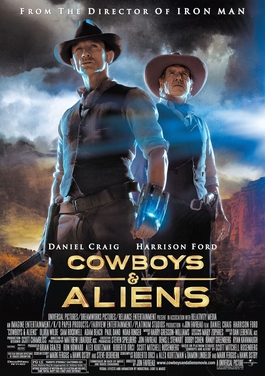
5. Cowboys and Aliens, which was okay. They didn't screw it up, which is more than I can say for Transformers by Michael Bay.
File:Cowboys & Aliens.jpg

There is some pretty cool stuff in literature too, and I was so glad to find as much as I did here: http://www.goodreads.com/shelf/show/weird-west
I'm considering potentially getting into the Dark Tower series. Maybe. Not sure. Not typically a Stephen King fan. We'll see.
I'll get around to reading another awesome concept, The Cowboys of Cthulhu. No, really! That's a real thing! Look! http://www.amazon.com/Cowboys-Cthulhu-Riders-Weird-West-ebook/dp/B005VRWR9Y
I'll letcha know how that one goes. Another series that looks darned promising that I've heard about before is the Merkabah Rider, a Jewish mystic travelling about the West fighting evil. If nothing else, that Volcanic repeater he has looks wicked cool!
http://www.amazon.com/Merkabah-Rider-Tales-Planes-Drifter-ebook/dp/B002ZG8FPY/ref=sr_1_1?s=digital-text&ie=UTF8&qid=1396845948&sr=1-1&keywords=Merkabah+Rider

And yet I can't help but feel like there is a lot of untapped potential. Wild West mixes with just about anything! It can mix with fantasy, horror, scifi, alternate history, pirates, aliens, zombies, steampunk, dinosaurs, robots, mysticism, monsters, anything! It really seems to me anyway that only lately have people been trying to tap into Weird West, one of the coolest things since fire.

Don't worry, I'll be diving into some of the books floating around there, as I am so there for some of these cross-genre concepts. Still, I feel like there is room for exploration here. I'm amazed that there is so little cowboy/dinosaur stuff out there. I mean, come on, cowboys and dinosaurs! What could be more amazing than those put together? Okay, maybe sharks that can fire lasers from their faces fighting robot eagles that have talons coated with diamond battling honey badgers that can fart superheated plasma while samurai with lightsabers and flamethrowers are cutting down hordes of hippie zombies.

But that's a little farfetched. Samurai aren't terribly fond of flamethrowers. I think ya'll get what I mean though. Another thing I noticed to my delight is an upcoming convention called the Weird West Fest, check it! http://www.weirdwestfest.com/festival-info/
Hoping I can hop over there this year and have some fun. :D

Anyway, I'll review some of this stuff in the near future, and I hope that I have sparked imaginations and caught interest. :)
In fact, seeing some of this open territory here, I might take a stab at writing some Weird West myself... Hmmm...

Wednesday, April 2, 2014

Walter Dalrymple Maitland Bell of Karamojo, The Elephant Hunter of Legend

Few men have exhibited greater skill in the realms of hunting and riflery than the man known as Walter Dalrymple Maitland Bell, more commonly known as Karamojo Bell, named after a region he did much of his hunting in during his days in Africa.

Back in the day there were very few jobs more dangerous than ivory hunting in Africa. Sure, there were plenty of perilous professions in the old days: Being a lawman on the frontier, mining with unstable sticks of dynamite in rickety mine shafts, being a dad, all kinds of stuff. But I don't believe there was any job at the time that had more collective danger than ivory hunting in the African interior. For starters the disease that still takes root there is beyond belief. In fact, for most of recorded history Africa was explored only by native Africans and Arabs. Any time anyone from Europe tried going in they almost always died within a year, and that was with medication. The disease there kicked the collective tails of Europeans so hard that it wasn't until the discovery and usage of quinine from South America that a white man could sail within sight of the continent and not keel over from fever, sleeping sickness, malaria, and dozens of other illnesses that are hard to spell without a medical dictionary nearby. Suffice it to say that without quinine, most people were as good as dead there.
Heck, the explorer Samuel Baker was well stocked with quinine and he and his wife both almost died during their trip!

That was just the first hurdle though. You also had to deal with some natives who's national sport was "Killing Everyone Not In Your Tribe", an activity many took to with gusto. Now, this didn't apply to all groups there certainly, but notably groups like the Masai had a requirement that you had to kill someone to be awarded the status of manhood. Circumstances didn't matter all that much, as long as it was an adult and you were the one who did the stabbing. Throw in Arabs who weren't always fond of outsiders edging in on their ivory hunting and one would quickly find that enemies were in far greater supply than friends in the 1800's and early 1900's.

The landscape over many areas is pretty harsh. Scalding sun and groundwater in pretty limited areas, starvation and dehydration are problems even today for people who know darned well what they are doing.

Then you had to deal with some rather notorious venomous snakes such as the legendary black mamba, adders, boomslangs, several cobras and a few others and just a nightly walk became a peril. That's not even counting the big stuff! You have the usual assortment of lions, leopards, rhinos, hippos, crocs, cape buffalo and other animals who have well deserved reputations for destruction prowling around.

Ah, but that still leaves the elephant itself! Currently the largest land animal alive today it has a well deserved reputation for being kinda hard to kill and sometimes having a bad mood. Granted, the bulk of elephants will bolt to another zip code at the least hint of human scent, but you only need to torque off one to completely ruin your day. Angry elephants don't screw around. They don't just kill you, they will tear you apart and grind you into your base components as best they can, usually the only recognizable parts left being able to fit inside a one gallon bucket. On one hand, if there was a zombie apocalypse, it'd be VERY short in the African bush. Those things would get steamrolled right quick.

These are the many challenges that faced the hunters of ivory, where simply staying alive for long enough to cash in your tusks for money was quite an accomplishment. Plenty of danger, the kind of job no right minded man or woman would take.

And Bell would spend almost the entire first half of his life trying to get that job. Despite being born to a fairly wealthy Scottish family, the second youngest of ten brothers, the lad got it in his head that he wanted to be a hunter for a living. I imagine every kid assumes that they will have some sort of grand idea of what they want to be when they grow up. I had quite a few outlandish ideas when my age consisted of one digit. About 99.9% of us will mature and move onto more realistic jobs and look back on our idealistic youthful ideas with fond or embarrassed nostalgia.

Bell wasn't one of those people. It appears as though that he one day opened a fortune cookie saying he was to be a hunter and held onto the concept with a grip that would have made the most determined, lock-jawed crocodile shake his head in bewilderment as the unreasonable persistence. His parents died when he was six, and instead of just waiting a decade and a half to come into his inheritance he was utterly determined to be a professional adventurer and hunter. At first he wanted to hunt bison on the American plains. A bit too late for that however, as by the time he was around the plains herds had been ravaged by Union soldiers and hide hunters.

So he switched to the idea of ivory hunting in Africa, and be darned to anyone who stood in his way. His big brothers didn't quite see things his way, and seeming to chalk his fanciful ideas up to youthful extravagance, they instead shipped him off to schools to get an edumication. But in a display of rebellion that warms my heart, the lad treated the excursions like prison breaks. Woe to the school faculty who had to put up with him! As of yet I'm not sure how much bush craft skill he had at the time or what material he had access to, but I'd be willing to wager he read up on everything he could, for he was able to break away from the schools and do his own thing. Picking up odd jobs here and there he got an impressive amount of work experience and skills under his belt before he first set foot on African soil.

You see, instead of listening to boring lectures for the eight years he was at various schools for, he was pestering his older brothers day and night for enough pocket change to outfit him with a firearm, some odds and ends and a ticket to Africa. Most kids today can't keep one straight thought for a month at a time, but boy oh boy, Bell sure had his mind set on this! I like to imagine that his older brothers had premature gray hair by this point and finally granted him his request. Sixteen years old and he began his long road to riflery and hunting!

In truth he wouldn't get to begin officially hunting elephant until he was much older when he got his share of inheritance money, as Life threw every obstacle in his way with the exception of Godzilla and a zombie apocalypse, but I don't want to do an entire biography here.

What I will cover are some of his exploits in exploration, his amazing skills as a hunter and rifleman, his preferences on firearms and technique, and how he came to those beliefs.

For you see, Bell was not only one of the most successful and expert elephant hunters of all time, but in my opinion perhaps the best off-hand rifle shot that ever lived. And in a world where men around the globe strive to become the best, this is quite a claim.

Back in the day most elephant hunting was done with hand-held howitzers dubbed "elephant guns." Since these animals often weighed over five tons, there was quite a bit of meat and bone between the shooter and the soft bits that you had to tag in order to convince the animal to lay down and die. For most elephant hunting history this was done with black powder firearms, and since the power of black powder and bullet technology was very limited back then, you had only two choices for having a more powerful weapon: Increase the bullet size and weight, and increase the black powder charge.

Today we measure gunpowder in grains only, but for elephant guns it was measured in drams. http://en.wikipedia.org/wiki/Dram_(unit)
Typically the most popular arm of the day for this work was known as the 4 bore. The sheer size of these pill pushers is unreal, and could easily be listed as an anti-material weapon today.
Here's but a taste of what this type of thing was like to handle:
https://www.youtube.com/watch?v=ElmlIyOtf1Q

These guns could weigh up to twenty pounds and had bores big enough to stick your thumb into. Some people preferred the far more tame 8 bores, which would only badly bruise your shoulder. If you were really ballsy, then you might even try out the most absurd of shoulder fired weapons, the 2 bore!


On the Right is a 2 bore shell, on the left is a 700 Nitro Express.
Good grief, look at the bloody size of that thing! It looks like what you'd load into a 40mm grenade launcher for destroying a machine gun nest. The mighty 700 Nitro Express put in there for comparison looks diminutive by comparison. So, next time someone asks you in a firearm debate what the biggest bullet around is, now you know.

So basically, your average elephant tamer was a titanic shotgun going anywhere between the 8 gauge shotgun to the overcompensating 2 bore, which I'm presuming could double as a swivel gun for repelling borders on the high seas when pirates were about. Although that might just be me.

So what did Bell, reputed to be the best elephant hunter of all time use? His weapon of choice was the 7x57mm Mauser, also known as the .275 Rigby in England.
...

Okay, for those of you who aren't cartridge geeks, the 7x57mm Mauser is what was used by many soldiers near the end of the 1800's and by hunters of deer. It also fired a bullet about as thick as a number 2 pencil. For enemy soldiers and deer it was just dandy, but for elephants the size of stagecoach wagons? Just about every other hunter on the continent thought this Scottish gent was a few cents short of a dollar. A puny cartridge in a bolt action just wasn't going to cut it, right? Well, that's where Bell really garnered attention. He used small bore high velocity cartridges to kill just about everything he came across with unnerving lethality due to his unbelievable marksmanship, superb knowledge of animal anatomy and exclusive use of solid bullets.

For some idea of what he was able to bag over his years of ivory collection, he had a confirmed elephant count of about 1,011 animals under his belt. Personally I think the true number is higher, as he used a variety of cartridges to get these animals. Aside from the 7x57mm he used the .303 British, .318, 416, .450-400, .360, and .256. Two of these, the ones beginning with four, were hefty cartridges but not regarded as elephant medicine. Even so, Bell used all of these to collect a larger number of elephants than any other man in history. I've seen some estimates go as high as 2,000, which doesn't strike me as being unreasonable. His true body count is of course impossible to know, but it's pretty safe to assume that he's got the grand title. Granted, much of his success was due to potting elephants out in the open plains rather than following them into the thick brush, but that doesn't demean his accomplishments at all. If one elephant sounded the alarm every other animal within earshot would leg it to another territory.
So he had to ace them instantly, letting them crumple to the ground and have his pals just figure that the old boy was taking a nap. This isn't unlike the bison hunter tactic of sniping herds from a distance, slaying dozens before one would be only wounded and start a stampede. That being said, bison are a tad easier to kill than elephants, especially when going for brain shots!

You see, early on in his career young Bell learned a lot about hunting and shooting, but also took some drastic diversions from conventional wisdom. One of his first stints over in Africa was acting as a meat hunter and guard for a caravan and was armed with a Frazer rifle. There was however a major problem. Not with the rifle itself per se, but rather the cartridges and the powder inside. The .303 he had was using the newest thing on the rifle market, cordite, the first of the smokeless powders. It provided far more velocity for a smaller package, and didn't leave a big plume of bluish smoke when fired. The problem with this stuff was that when a shell was sitting in the rifle all day in the intense African sun, the powder was heated and when fired the powder burned much faster than normal, producing far greater pressures than it was meant to.

This had the unfortunate side effect of making the brass shell swell and refuse to budge from the chamber. It was only with stiff application of a cleaning rod shoved down the barrel that Bell was able to extract the shells and reload which was a huge problem, especially if there was a group of blood-thirsty Masai charging or a pride of lions. In fact, in that area and time the notorious Tsavo Man-eaters were out and about making themselves famous and making the British look right foolish. Essentially having the same rate of fire as a muzzleloader, Bell realized that he had to make each and every shot count under any and all circumstances, for he wouldn't get a chance to make a second. This was the first step for him becoming a wondrous shot.

The second step was the second rifle he was able to acquire. Trading the Frazer for a Winchester falling block, most likely a Winchester 1885 in some manner of .45 cartridge, a fantastic setup by the way, Bell was set up with a much more reliable rifle but again there was a problem with the cartridge. This time the fault was with the bullet itself. The ones he acquired through the trade were an experimental type, hollow point copper capped bullets. They were meant for almost instant expansion, and this was back when hollow point designs were new and still being tried out. People were still tinkering with controlled expansion and such, with these likely being an early prototype of some sort. They had a pretty glaring problem however, that being they would expand so quickly that they wouldn't penetrate worth a crap. And when you're dealing with animals that have big bones and lots of meat, penetration is the name of the game, so this was a bit of a setback. This was demonstrated most vividly in one of his first encounters with a lion.

While out and about with the caravan some of the boys said that they saw a lion drinking by a near by pool of water, so Bell and an African decided to try and pot him. While I'm not sure which .45 Winchester cartridge type he was using, a casual bit of research will reveal that many of them were decent bison slayers. While some were less potent than others, just about all of them were good at lobbing heavy slugs into targets with reliably impressive results, so Bell was within reason to be confident when he delivered a bullet right into the cat's face. However, things didn't go quite as well as planned, as instead of having its skull scattered over several square yards it seemed to only be mighty peeved. Long story short, Bell had to deliver two more shots to the darned thing and be assisted by a big group of beaters armed with bludgeons and knives to convince it to die.

Upon examination he discovered that his first shot had broken the animal's jaw, preventing it from exerting its full strength with biting. This was extremely lucky, as when the beaters rushed in there was a darned good chance of at least one man getting an extremity bitten off and this prevented anyone suffering any real harm. The other bullets didn't penetrate the thick, hard muscle at all. They just flattened like pancakes on the flesh and didn't cause any major injury of any kind. For those of you who've not had the pleasure of reading about the intrigues of dangerous game hunting, a wounded animal is far more dangerous than a healthy one because an injured one is much more likely to charge and maul someone, whereas a healthy animal is more likely to simply run away.

Bell then came to the conclusion that straight, unwavering penetration through any and all obstacles with proper bullet placement was paramount. First chance he got he switched to solid bullets usually plated with copper or nickel. Unlike most bullets solids don't deform, mushroom, expand or lose their shape in any way. They go through flesh and bone in as straight a line as one could hope. Many decry that these don't produce a big enough wound channel to be immediately fatal, or worse insist that they impart no "shock" value and will only create very narrow, slow bleeding wounds. I shan't bore you all with one of the most intense controversies within the ragged battlefield of terminal ballistics, but suffice it to say that Bell broke quite a few assumptions and proved to be exceptionally deadly with his little solids.

One of my favorite quotes of his is "And 100 grains in the right place are as good as ten million." He certainly seemed to prove that!

With his knowledge of animal anatomy, unwavering aim and bullet selection Bell would prove to be one of the most lethal riflemen to have ever walked this earth. He broke down hunting to a darned science, as proved during his very first case of dealing with elephant. It took a darned good bit of time for him to actually get a safari outfit put together, as he didn't actually get a real gig going until he got his own chunk of inheritance money, but we'll mention some of that later.

Bell had come to the conclusion that the best way to slay any animal was to put a bullet into the vital organs at any cost, and that no matter how large or small the bullet would do its work. For elephants he wanted the most surefire death-shot he could possibly make: The brain shot! Ah, but an elephant's head is a bit bigger than that of most animals, and when dealing with them missing by even an inch is just as bad as missing altogether. Bell was determined to find out exactly where that piece of gray matter was and was given a tip as to where they lay. However, he found this initial information to be faulty, as when he first fired upon a group of bulls his shots didn't seem to worry them at all!

Picking up on the fact that this wasn't part of the plan he switched to delivering a heart shot, which brought down one of the bulls. The thing threw a brief fit and died, but it was enough to make the others head for the hills. He then had his employees hustle back to an acquaintance of Bell and bring a beefy logging saw. You know, those big two handled ones you see in cartoons where two men take turns pushing and pulling and is longer than then are tall? Yup, one of those. Bell then sawed the darned bull's skull in half to find out exactly where the soggy computer was. After that brain shots were no longer a problem.

From that point Bell delivered brain shots with the sort of precision usually reserved for surgeons. Although he would use heart and lung shots too with excellent results, his superb skill at braining elephants was almost supernatural. He could tag them from just about any angle one could think, including from behind! Okay, not directly from behind, but pretty darned close. In fact, Bell's knowledge of internal anatomy, superb marksmanship and solids he was able to kill almost any animal from almost any angle. He was quite fond of "raking shots", a shot where the bullet would travel lengthwise through an animal, hitting multiple vital organs and causing loads of tissue damage which would mean almost certain death.

Bell's diagram of rear brain shot. A tad bit tricky to pull off.
Bell didn't like knocking on bigger cartridges and rifles however, rather he was quite mature in his writings and understood that there are many styles and methods of hunting, some of which suit some men better than others. To quote from Wanderings of an Elephant Hunter "Each hunter should use the weapon he has most confidence in."

He did in fact use a variety of different rifles and of different calibers, and for the most part settled on the 7x57mm Mauser as it was the most reliable weapon that he used. In several examples we'll see that he tried using a Lee Enfield in the .303 British, a decent weapon. He hoped to make use of the large ten round magazine, but he had trouble with the reliability, as he often had misfires and other problems. Even so, he used it to darned good effect!

He was quite fond of the bolt actions due to their lightness, ease of handling, reliability, ease of reloading and the rate of fire. He didn't necessarily advocate the hypervelocity bullets that are quite common today, but rather moderate velocity projectiles at around 2,500 fps. Later on he would write that one should use solids with round noses and not the spritzers that became more common, as the sharp pointy bullets were far more likely to lose their course and veer away from the intended targets after impact. Tumbling is a nasty problem sometimes, and the spritzer is more likely to do so. In the 50's however he did advocate the idea of using 220 grain 308s if he were going to go hunting elephant again. That's quite an endorsement!

But lets get into some of the specific examples of his exemplary marksmanship!
In one case he travelled to some new territory called Bukora and set up camp when some local Karamojong showed up seemingly out of curiosity. Bell's headman noticed some bad signs though: Not a woman was in sight and clusters of spearmen began following members of Bell's staff as they went about their business. Women tend to be scarce only when a fight is about to happen, and it looked very much like the Karamojong were getting ready to have themselves a spearing party.

Bell realized this would put quite a crimp in his ivory hunting and with a darned impressive head for diplomacy decided to kill several birds with one stone. Being a business man, shooting a bunch of natives even in self defense wasn't something that would overly endear him to the people, and he wanted all the support he could get. So, he decided to put on a little show to convince the visitors in an innocent manner that he wasn't someone to be screwed around with.

He announced he was going out to hunt some meat. He went out he was well within visual range when a herd of zebra popped up and bolted off. Bell, most likely wielding a Lee Enfield sporter, dropped ten of the animals while working the bolt as fast as he could from an offhand position.
Now just take a moment to let those factors sink in: Ten shots. Ten zebra. Running at full speed. All ten drop instantly. Bell was almost certainly using iron sights, nor did he assume any sort of stable shooting position. He was standing, which is the most wobbly position of all. And he did this firing as fast as he could. That is amazing.

In the book Death in the Silent Places written by Peter Capstick he comments on this particular incident with astonishment. To quote him directly "The zebra is one of the toughest of all 'plains' game and impossible to kill instantly, unless hit exactly right. To knock of ten in a row, firing as fast as possible, is a feat I doubt one man in 10,000 could pull off. But then, Bell was one in several million."
For the record, Peter Capstick worked as a professional hunter in Africa and South America, who was in on thousands of slain animals, no small amount of experience.

Needless to say, this display impressed the heck out of the watchers in camp. To them this was nothing short of magical. Heck, I've seen some darned good shooting and I'd consider a display like that supernatural! Bell even went so far as to not reload his gun so that they would assume he had more ammo in the magazine and didn't need to top off. They had a change of heart after this display and figured it would be best to remain friends with this particular white man.

In another case he found that the huge stock of .318 cartridges he'd purchased were rather faulty, with about one in three misfiring. When dealing with possibly upset charging hairless mastodons, one of the last things you need is a bullet that has decided that it doesn't want to go off.
What to do with 6,000 cartridges? Blaze away for amusement of course! At Lake Victoria by some falls at Jinja he decided to get rid of the crappy shells by taking shots at cormorants that roosted along the rocky shelf. Most of these targets were about a hundred yards above him, flying at around forty to fifty miles per hour. I myself wouldn't bother shooting at targets like that.

Bell however was able to connect at least half of his shots at these nigh impossible targets! At half that distance most people have trouble hitting them with shotguns. Yet he was able to tag them with unnerving regularity. Do you have any conception of how hard it is to hit a target moving at all, let alone flying at a distance with iron sights? I haven't even heard of anyone trying anything like that in recent times, although if any of you happen to know about such exploits I'd be more than happy to learn about it!

Although he didn't use handguns very often for hunting and didn't appear to consider himself a pistolero, he certainly proved himself to be a good hunter with the Colt .45. Before he was able to start his ivory hunting, he tried getting his funds by gold mining up in the Klondike in Alaska. However, he found that the shovel wasn't nearly as satisfying to use as his rifle, and with his already considerable knack for hunting took a different job: Hunting for meat. The camps were in short supply of red meat and cost a good bundle. So what did our enterprising hunter do? He teamed up with an American who had a dog sled team, set off into the bush and began shuttling meat back and forth.

Bell would collect the meat, and his partner would sell the stuff. The young Scotsman proved to be quite good at this. In fact, he developed a particular trick for taking down moose. Using his partners Colt .45 single action, he'd chase moose into deep snow drifts where they would flounder and then deliver brain shots at close range. I don't believe there is anyone within my generation who loves the .45 Colt more than I, but even I will concede that back in the day the cartridge was not up to big game slaying. Yet Bell made that work too! Boy, would I love to be able to use a six shooter that well!
Sadly, Bell didn't get to make off with the hefty bundle he'd earned. His partner pretended to deposit their earnings at the bank, and on one trip didn't return. When Bell got fed up waiting for him to return and made the journey himself, he found that the scoundrel had taken every cent for himself and left town! It's lucky for him that Bell never caught up with him, because I imagine things may have gotten a might ugly.

Another example of his pistol use, while not in a hunting sense, certainly was interesting. When he was underway with his ivory hunting he had a decent variety of rifles, but also purchased a Mauser "Broomhandle" pistol with a removable stock that could turn it into a carbine. Near Zanzibar in now Tanzania white men weren't at all welcome in the interior.
This is because by this point in time Europe and the Americas had made an amazing 180 on the concept of slavery. England in particular had begun an all out purge of slavery around Africa. That's not to say that all men had abandoned the love of slavery, but the citizen sentiment and government had a big enough majority to begin trying to abolish the institution.

The British Navy at all times had ships prowling the African coasts, seizing Arab boats that were transporting captured African. As Europeans began seizing more chunks of the coast the only places that seemed safe were within the interior. So a white man of the British Isles poking around "hunting" was always regarded as a very obvious spy, scouting out routes and locations for oncoming columns of soldiers with modern rifles. So the various Arabs and other Africans, who absolutely loved raiding and enslaving other people, as long as it wasn't themselves, decided to set up some trouble for the young explorer.

Bell and his men were watering the herds he had when a troupe of young spearmen showed up and began trying to drive the herd animals away and one even went about trying to lance holes in the canvas ground cloth that was used to water the animals. Bell wasn't too thrilled with this. To make the story short, he took out the Mauser and began convincing them that their current activities were unwise. Okay, he didn't kill anyone, rather he startled the almighty crap out of them, making them dance and leg it for the hills, with one man captured. Bell then demanded a hefty payment for his release, which was granted. He didn't have quite as much trouble in that area after that.
To be fair, it wasn't so much the tribesmen's fault. It was almost certain that they were put up to the confrontation by the hostile Arabs.

Just about everything in his sights could be slain. In all my research on hunters in the field I've never found anyone who approaches the consistency of accuracy on so many different targets as Bell. In World War 1 he actually took to becoming a pilot, presumably because he wanted it to be a fair fight. As this article is mostly about his hunting and rifle skills, I won't dwell much on his warfare exploits, although he was embroiled in a few, including the Second Boer War. That being said, it was most fortunate for the Germans that Bell wasn't a scout like Pretorius, as at one point Bell was armed with a prototype semi-auto rifle. Could you imagine this man if he had been in a target rich environment? There'd have been enough dead to make a darned palisade!

Actually, considering the many circumstances that he was in, Bell did an astounding job of evading conflict with the many tribes. In all I've read I haven't found one case where he killed an African. He killed a few Germans when fighting as a pilot, but he seemed rather adverse to shedding human blood from what I gather.
In fact, he was actually nothing short of brilliant in his dealings with the men of the bush, doing everything he could to court favor, make friends and reduce the chances of attacks on his expeditions. Considering the amount of ivory he collected, it seems he did a good job.

To understand his public relations tactics, one has to consider how many of them regarded elephants. Now, the idea of a single man killing over a thousand animals would seem nothing short of appalling to us today. In actuality that kind of hunting was considered a wonderful gift to the local peoples. You see, elephants had a nasty habit of raiding their crops during the night, wrecking their food supplies that were supposed to feed entire villages. Few of them had the weapons or skill to kill one elephant, let alone a small herd in the dead of night.
So if a man came along wishing to kill said animals, the villages were most appreciative of his services and went out of their way to ask them to provide help. Bell in particular collected the ivory and made a point to give out the meat left over to the people who helped him find them, carry his gear or let him stay within their villages.

Another tactic he used that helped dramatically was the promise of a cow to anyone who could lead him to good herds. To the men of the bush, this was the equivalent of being promised one million dollars, an extraordinary sign of wealth. Men lower in the pecking order could only acquire cows through raiding other villages, a dangerous job. But just to find some elephants and not even having to kill them himself? The locals were ecstatic at these arrangements, and certainly put him in good graces.

And why not? After Bell was done they'd have at least tons of meat which would cost them a huge amount of effort and probably a few lives. Starvation has built a happy home in Africa, but Bell made him leave for a time. Bell's business sense and relations with the locals was quite brilliant and was undoubtedly a huge factor contributing to his success. He gathered a huge following, all enjoying being in his employ.

Another interesting thing was his position on slavery. While he didn't go around blasting raiding caravans, as that would have made him a huge number of enemies, he didn't let slavery take place within his expeditions at all. I have no doubt he was against slavery, and this is best revealed when he dealt with a gent under the name of Buba Gida. The man was described by Bell himself as a despotic tyrant, in command of a huge number of men and a massive fortress city. Buba Gida ruled with complete authority, although he did not export slaves on the Arab ships like some did, and just kept them to himself.

Having fashioned Bell with a caravan of porters they began heading out into the country. The tyrant was using the Scotsman as a shield, pretending that his men were acting under respectability of a man of England and thus above suspicion. Bell wasn't exactly thrilled. So when out in the bush Bell made sure they had an understanding: The porters wouldn't enslave everyone in sight, and Bell wouldn't shoot them or shackle them and run them to the nearest European military outpost. The Scotsman positioned himself behind the group and just happened to have his rifle. So there wasn't any unauthorized nabbing of native folk on that trip.

On returning to the area Buba Gida learned what happened and was livid. However, killing a white man so close to English power was kind of a bad move, and Bell had made enough gifts to warrant being spared. But it was clear that the gent wasn't welcome in that region any longer and Bell departed.

In fact, despite his resolute refusal to have his own party members harmed and certainly would have spilt gallons of blood in defense, the man seemed curiously reluctant to inflict violence on his fellow man unless as a last resort. There were plenty of occasions where negotiations had to be done at the point of a rifle, yet thankfully it never came down to pulling the trigger. The only men I know he killed himself was a pair of German pilots. It's possible that in his own writing he left out any cases where he killed anyone in self defense or otherwise, but I don't think that's the case. In everything I've read of his he seems very honest and matter of fact, with very little anger or negativity, seemingly having a feeling of neutrality about most things.

Pretty surprising he had such a small body count considering the places he worked in! PJ Pretorius killed about fifty cannibals in self defense in just one battle, firing his double barreled shotgun fast enough to melt the bloody solder and render it useless! While it's impossible to know exactly how many he killed, he was in fact arrested officially for the murder of 50 natives, so we've got a pretty good indicator. Yet Bell got off seemingly without any notches carved on his hilt. I really get the impression that he didn't wish to kill anyone.

Yet despite the insane number of dangers that Bell undertook and all the perils he faced, he is one of the few ivory hunters who lived long enough to retire and enjoy the money from his proceeds. He was able to live comfortably in England with his wife until his death in 1951, although his adventures didn't cease. He continued to hunt in the hills near his home and even used his private ship to help evacuate soldiers from France during Operation Dynamo in World War 2.

There are many, many more adventures he had during his travels in Africa, but I don't want to swamp this article with more than one desires. To cover all of his exploits would require a large book, if not several. I've tried to hit the highlights, although it may seem a bit jumbled, as Bell seemed allergic to writing about his adventures with dates attached to them.

Before closing this however I would like to look at some more of his ideas and techniques with rifles. After all, someone who used off the shelf rifles and factory ammo with laser precision can certainly teach us a bit! He believed in using iron sights with both eyes open, as the greater field of view would allow one to see that which the sights covered up. Although at this point in time there were only primitive telescopes and it's unlikely that he would have wanted to mess with such finicky devices.

He also believed in mastering ones' nerves and not fire prematurely through excitement. Practice with his personal arms was constant, working with them until he could wield them like extensions of his own limbs.

Here is a quote that I believe riflemen today can look at and hopefully improve some of their craft.

"The thing that did most for my rifle shooting was, I believe, the fact that I always carried my own rifle. It weighed about 7 lb., and I constantly aligned it at anything and everything. I was always playing with it. Constant handling, constant aiming, constant Swedish drill with it, and then when it was required there it was ready and pointing true."
This reminds me of the old saying "Beware the man with one gun. He probably knows how to use it." How true it was for this man! Who'd have thought familiarity with someone's gun could pay off?

Overall, Bell was an outstanding example of a professional adventurer and hunter. When he set his mind to something he went through with it regardless of the obstacles. He combined a keen intellect with the peak of physical fitness to traverse tens of thousands of miles on foot and survive everything the Dark Continent threw at him. He was a humble man who did not use his well earned success to brow beat others or to inflate his own ego, but rather regarded himself as just another hunter hoping to impart some of his knowledge. He didn't shed blood without cause and did his best to make sure that the meat of his kills didn't go to waste.
He was civil and respectful to everyone he met within the bush, both Africans and men of Europe, earning himself a great deal of respect from those around him. He was a gentleman who had a love of nature and adventure while being in my opinion the best all around rifleman that ever lived, as well as one of the best hunters.
He was the epitome of the gentleman hunter explorer, and one of my personal heroes.

If you wish to read some of his writing, I've managed to find an online version of his first book, The Wanderings of an Elephant Hunter here:
https://archive.org/details/wanderingsofelep1923bell
There are two other books, Karamojo Safari and Bell of Africa, which as of now I've not been able to acquire. Hopefully I can get them in time. In the meantime, enjoy!